Now in Claude: generate images & videos from chat
Connect

21 Faceless YouTube Channel Ideas That Make Money

21 proven faceless YouTube channel ideas for 2026 with CPM ranges, content formats, and earnings. Pick a niche and start a faceless channel that actually pays.

Guide26 min read

Create Your AI Influencer

Join 300K+ creators earning with AI-generated content. No technical skills needed.

Start Creating

The hardest part of starting a faceless YouTube channel is not the videos β€” AI handles those now. It is picking a niche that people actually search for, that advertisers pay well to reach, and that you can produce without ever showing your face. Choose right and the algorithm does the heavy lifting. Choose wrong and you will burn months on a niche with no demand or no ad revenue.

Faceless YouTube channel ideas across stoicism, history, science, and finance niches

This is a list of 21 faceless channel ideas that are proven to work β€” each with its typical CPM, the format that performs, the kind of content to make, and a realistic earnings range. They are grouped from highest ad value to highest reach, so you can match a niche to your goal.

Updated August 2026 with current niche, workflow, and format trends.


How to Pick a Faceless Niche That Pays

Before the list, the three filters that separate a profitable niche from a dead one:

  • Search demand. People must be actively looking for this content. A niche with no search volume means relying entirely on the algorithm to push you, which is slow and fragile.
  • CPM (ad value). Finance pays $15–$40 per thousand views; entertainment pays $3–$8. A finance channel needs a fraction of the views to earn the same money. High CPM means less reach required.
  • Automatable format. The content must work without a human presenter β€” narration over visuals, AI characters, B-roll explainers, or text-on-screen. If a niche needs a real face, it is not a faceless niche.

The best ideas below score well on at least two of these. The highest earners β€” finance, business β€” win on CPM. The fastest growers β€” pets, facts β€” win on reach. Pick based on whether you want fewer views at high value or more views at lower value.

A faceless YouTube niche planning board covering space, history, finance, science, nature, and storytelling

$15–$40 Finance CPM $3–$8 Pets CPM 1,000 Subs to monetize 4,000 hrs Watch time
needed

High-CPM Authority Niches (Fewer Views, More Money)

These niches have the highest ad rates on YouTube. A modest audience can out-earn a viral entertainment channel because advertisers pay a premium to reach buyers.

1. Finance & Investing

  • CPM: $15–$40 (the highest on YouTube)
  • Format: Narrated concept explainers over clean data visualizations and charts
  • Content: "The 50/30/20 rule explained," "What banks don't tell you about savings," index-fund breakdowns
  • Earnings: A channel at 300K monthly views can clear $4,500–$12,000/month from ads alone

2. Money & Side Hustles

  • CPM: $10–$25
  • Format: List-style scripts with motion graphics and on-screen text
  • Content: "7 quiet habits of people who become wealthy," side-hustle rankings, frugal-living systems
  • Earnings: $1,400–$3,100/month at moderate scale, with strong affiliate upside

3. Business & Entrepreneurship

  • CPM: $10–$30
  • Format: Case-study narration, company breakdowns, founder stories over B-roll
  • Content: "How [company] actually makes money," failure post-mortems, business model explainers
  • Earnings: $2,000–$18,000/month at 200K–600K monthly views

4. Technology & AI News

  • CPM: $10–$25
  • Format: Voiceover news roundups with product visuals and screen captures
  • Content: Weekly AI tool roundups, "what's new" explainers, gadget breakdowns
  • Earnings: Consistent search traffic plus sponsorship potential; $2,000–$12,000/month

5. Real Estate & Wealth

  • CPM: $12–$30
  • Format: Narration over property imagery, maps, and data overlays
  • Content: Market explainers, "how to buy your first property," wealth-building strategy
  • Earnings: High CPM, niche but loyal audience; $2,000–$10,000/month

Wisdom & Mindset Niches (Evergreen, Loyal Audiences)

These are some of the fastest-growing faceless categories in 2026. They retain viewers, build loyal subscribers, and the content never goes out of date.

6. Stoicism & Philosophy

  • CPM: $6–$14
  • Format: Calm narrated wisdom over cinematic, atmospheric B-roll
  • Content: "10 Stoic rules that will change your life," "Marcus Aurelius on dealing with toxic people"
  • Earnings: Explosive growth category; channels hit 300K+ subs fast, $1,800–$4,200/month

7. Self-Improvement

  • CPM: $8–$15
  • Format: Narrated frameworks and habit breakdowns with clean visuals
  • Content: "20 tiny habits that compound into a new life," "why you feel behind and how to stop"
  • Earnings: Evergreen demand, $480–$1,400/month growing steadily with library size

8. Motivation

  • CPM: $8–$15
  • Format: AI character or voiceover delivering speeches over cinematic backgrounds
  • Content: Morning motivation, discipline and mindset pieces, short-form daily clips
  • Earnings: Huge view volume potential; $4,000–$30,000/month at scale

9. Philosophy & Big Questions

  • CPM: $5–$12
  • Format: Narrated essays over abstract or cinematic visuals
  • Content: "What is the meaning of a good life," thought experiments, classic-idea explainers
  • Earnings: Deep watch time, loyal niche; $800–$2,500/month

Story & Curiosity Niches (High Watch Time)

Storytelling formats keep viewers watching, which the algorithm rewards above almost everything else.

10. History & "Did You Know"

  • CPM: $4–$12
  • Format: Narration over period imagery, maps, and AI-generated historical scenes
  • Content: "The war that started over a bucket," "the day Pompeii disappeared," ancient mysteries
  • Earnings: Broad appeal, high retention; $920–$2,600/month and very scalable

11. Science & Space

  • CPM: $6–$15
  • Format: Voiceover over generated visuals of cosmic and scientific concepts
  • Content: "What if Jupiter was a star," black-hole explainers, "the Voyager's final message"
  • Earnings: Massive curiosity-driven reach; $1,100–$2,800/month, often far higher on viral hits

12. True Crime & Stories

  • CPM: $5–$12
  • Format: Dramatic narration with atmospheric AI-generated scene illustrations
  • Content: Case retellings, unsolved mysteries, narrative deep-dives
  • Earnings: Enormous audience, excellent retention; $2,500–$36,000/month at high view counts

13. Unsolved Mysteries & The Unexplained

  • CPM: $4–$10
  • Format: Suspenseful narration over eerie, moody visuals
  • Content: Disappearances, strange phenomena, "things science can't explain"
  • Earnings: Binge-friendly format drives session time; $1,000–$8,000/month

14. "What If" & Hypotheticals

  • CPM: $5–$12
  • Format: Speculative narration over AI-generated scenarios
  • Content: "What if the dinosaurs never died," alternate-history and future scenarios
  • Earnings: Highly clickable; $1,000–$6,000/month with viral spikes

Mass-Reach Niches (High Volume, Lower CPM)

Lower ad rates, but the reach is enormous β€” and volume compensates. Great for fast subscriber growth.

15. Pets & Animals

  • CPM: $3–$8
  • Format: Narration over animal footage and AI visuals, list-style facts
  • Content: "12 things your cat wishes you knew," "14 foods cats should never eat"
  • Earnings: Massive reach (millions of views per video possible); $620–$1,800/month and climbing fast

16. Facts & Top 10 Lists

  • CPM: $3–$9
  • Format: Narrator presenting ranked facts with relevant AI visuals
  • Content: "Top 10 strangest places on Earth," ranked list-style content on any topic
  • Earnings: Algorithm-friendly, endless ideas; $1,000–$10,000/month by volume

17. Geography & Maps

  • CPM: $4–$9
  • Format: Narration over animated maps and data visualizations
  • Content: "Why this tiny country is so rich," border explainers, "how big is X really"
  • Earnings: Educational evergreen reach; $800–$5,000/month

18. Reddit Stories & Internet Drama

  • CPM: $3–$8
  • Format: Voiceover reading curated stories over gameplay or B-roll loops
  • Content: AITA-style stories, revenge and relationship threads, "best of" compilations
  • Earnings: Extremely high watch time; $1,000–$8,000/month at scale

Calm & Entertainment Niches

19. ASMR, Sleep & Relaxation

  • CPM: $4–$10
  • Format: Soothing AI-generated visuals with ambient audio
  • Content: Sleep stories, rain-and-fireplace loops, calming nature scenes
  • Earnings: Very long watch times boost the algorithm; $1,500–$10,000/month from sheer hours watched

20. Gameplay-Loop Explainers

  • CPM: $5–$12
  • Format: Educational narration over satisfying gameplay loops (the format blowing up on Shorts)
  • Content: Any explainer topic with calming gameplay behind it for retention
  • Earnings: The dominant Shorts format in 2026; $1,000–$8,000/month

21. Movie, Anime & Story Recaps

  • CPM: $3–$8
  • Format: Fast-paced narration over clips and AI-generated scenes
  • Content: Plot recaps, "ending explained," character breakdowns
  • Earnings: Huge search demand; $1,000–$9,000/month (mind copyright β€” favor commentary and AI visuals)

How to Actually Make These Videos (Without a Camera or Editor)

Picking the niche is half the job. The other half is producing videos consistently β€” and this is where most people stall, because doing it manually means writing scripts, recording voiceovers, sourcing footage, and editing for hours per video.

A faceless video production workflow from topic and script to voiceover, storyboard, captions, and finished video

The faster path is an automation tool that produces the whole video from a topic. You choose one of the formats above, type your topic, and get back a finished video with script, voiceover, visuals, music, and captions.

The general workflow, regardless of niche:

1

Pick a niche and format

Choose from the 21 ideas above based on whether you want high CPM or high reach, then pick a matching format (narration, character, gameplay loop).

2

Generate a batch of videos

Produce 10–15 videos before launch so you can post on a consistent schedule from day one.

3

Optimize titles and thumbnails

Front-load keywords, use a curiosity gap, and keep thumbnail text to 3–5 high-contrast words.

4

Post daily and read the data

After 20–30 uploads, double down on the topics and thumbnails that outperform.

For the complete production and growth playbook, see the faceless YouTube channel guide. To understand the automation model and how to scale to multiple channels, read YouTube automation explained. And for full earnings breakdowns by niche and platform, see how to make money with AI content.


Validate a Channel Idea in Seven Days

A niche can look attractive on a spreadsheet and still fail in practice. The fastest way to discover the difference is a small publishing test. Do not buy a year of software, commission a brand package, or produce 50 videos before you know whether viewers respond to your angle.

Day 1: map the audience promise. Write one sentence that finishes this thought: β€œPeople subscribe because every video helps them…” A space channel might promise to make difficult cosmic ideas understandable in under a minute. A finance channel might explain one useful money decision without jargon. If the promise changes from video to video, the niche is still too broad.

Day 2: collect 30 topic signals. Use YouTube autocomplete, the β€œpeople also watched” panel, comments on established channels, Reddit questions, and Google Trends. Record the exact phrases people use. Separate evergreen questions from short-lived news so your first batch is not obsolete before it is published.

Day 3: write ten titles before making a video. A workable niche produces titles easily. Aim for three search-led titles, three curiosity-led titles, two contrarian angles, and two stories. If all ten feel like the same idea with different wording, narrow or reposition the niche.

Days 4–5: produce three pilot videos. Keep the visual format consistent but test three hooks. Review each export for factual errors, awkward pronunciations, repeated imagery, caption timing, and dead air. AI can assemble a first cut; you are still the editor responsible for the final claim and frame.

Days 6–7: publish and read behavior, not vanity metrics. Early view counts are noisy. Look first at click-through rate, the first 30 seconds of retention, average percentage viewed, rewatches on Shorts, and comments that request a follow-up. A small video with strong retention is a better signal than a larger video whose audience leaves immediately.

At the end of the week, choose one of three actions: continue the niche unchanged, keep the audience but change the format, or stop before spending more. The goal of a pilot is not to prove your first idea right. It is to buy useful evidence cheaply.

A faceless channel analytics review showing audience retention, performance panels, and a notebook for observations


A Quality-Control Checklist for Every Faceless Video

Automation makes publishing faster, which also makes it easier to publish weak work faster. A short preflight check protects watch time, credibility, and monetization eligibility.

  • The opening pays off the title. The first sentence should confirm that the viewer clicked the right video, then create a reason to stay. Remove greetings, channel introductions, and generic scene-setting.
  • Every factual claim has a source. For finance, health, science, history, and news, keep a research note with the source beside each claim. Do not let a fluent AI sentence pass as evidence.
  • The narration sounds intentional. Fix names, acronyms, numbers, pauses, and emotional emphasis. Change the voice or regenerate a sentence if it sounds synthetic; do not hide weak narration under louder music.
  • Visuals support the sentence. A pretty image that contradicts the script lowers trust. Check maps, flags, uniforms, charts, dates, product screens, and any generated text inside images.
  • The edit changes often enough. On Shorts, attention usually needs a visual change, crop, caption beat, or camera movement every few seconds. Long-form can breathe, but static sequences still need purposeful motion.
  • Rights and disclosures are clear. Use footage, images, voices, and music you are allowed to publish commercially. Disclose realistic synthetic media where a platform, jurisdiction, or context requires it.
  • The ending creates the next view. Replace a vague β€œlike and subscribe” with a specific next question, related video, or promised continuation.

Save this checklist as a reusable template. When production scales, the checklist becomes the quality floor that lets multiple formats or channels still feel deliberate.


Niche Selection Cheat Sheet

If your goal is…Pick from…
Maximum revenue per viewFinance, Real Estate, Business, Tech
Fast subscriber growthMotivation, Pets, Facts, Reddit stories
Loyal, evergreen audienceStoicism, Self-improvement, History
Highest watch timeTrue crime, ASMR/sleep, Reddit stories
Easiest to produce dailyFacts, Stoicism, "What if," Gameplay-loop

A practical strategy: start with one niche you find genuinely interesting (you will make better topic decisions), prove the workflow, then launch a second channel in a high-CPM niche once you have momentum.


How to Generate 30 Video Ideas in Any Niche

Picking a niche is step one. The fear that stops most people next is "I'll run out of ideas." You will not β€” every niche has the same repeatable idea angles. Run your niche through these six templates and you have 30 videos before lunch.

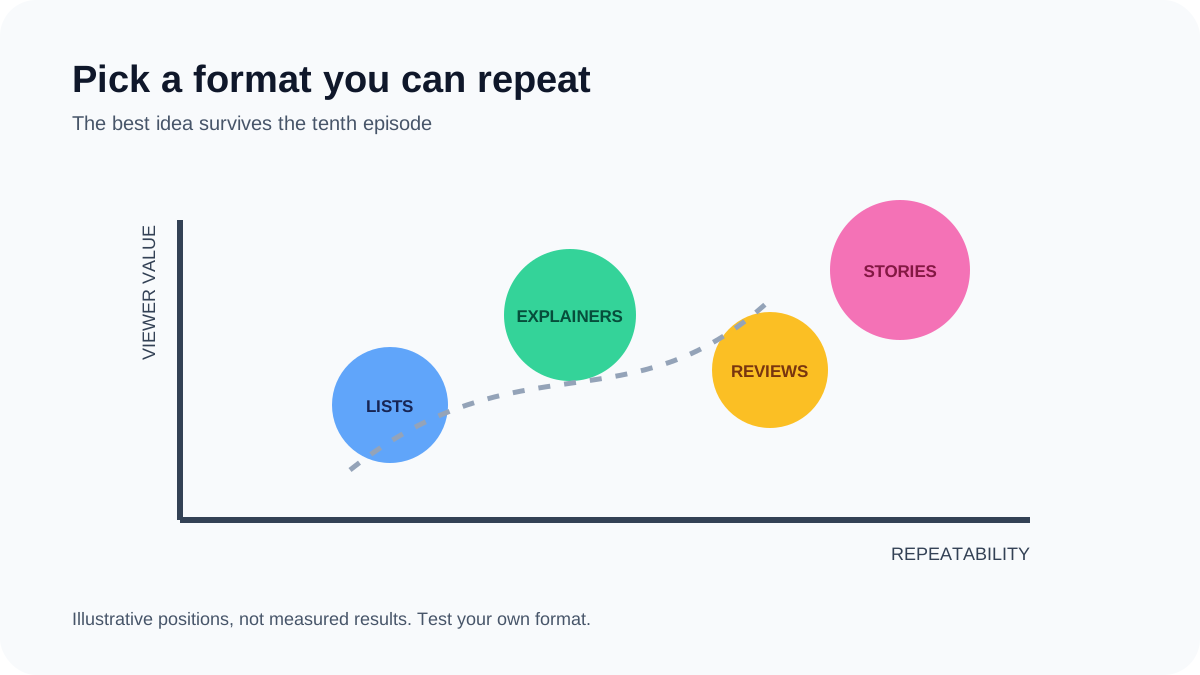
  • The Listicle β€” "7 [things] that [outcome]." Endlessly reusable: 7 Stoic habits, 10 strangest places on Earth, 5 money rules. These are the backbone of faceless channels.
  • The Explainer β€” "How [thing] actually works" or "Why [surprising fact]." Satisfies curiosity and ranks for search: why cats sleep on you, how black holes bend time.
  • The Story β€” A single narrative told dramatically: the day Pompeii disappeared, the war that started over a bucket. Highest watch time of any format.
  • The Myth-Buster β€” "The truth about [common belief]" or "[Popular advice] is wrong." Pattern interrupts earn clicks: the 50/30/20 rule is wrong, the 5AM myth.
  • The Comparison β€” "[A] vs [B]" or "What if [A] was [B]." Frames two ideas against each other: what if Jupiter was a star, saving vs investing.
  • The Hypothetical β€” "What would happen if [scenario]." Pure curiosity bait: what if the dinosaurs never died, what if you stopped sleeping.

Six angles times five topics each is 30 videos. Most faceless channels rotate these same six shapes forever, just swapping the subject. An automation tool turns each idea into a finished video in minutes, so the limiting factor is never production β€” it is just deciding what to make.


Example Video Titles for the Top Niches

To make this concrete, here is a small swipe file. Notice the patterns: a number, a curiosity gap, and a clear payoff. Adapt these to your niche.

Stoicism

  • 10 Stoic Rules That Will Change How You Think
  • Marcus Aurelius on Dealing With Toxic People
  • Why the Strongest People Stay Quiet

Money

  • 7 Quiet Habits of People Who Become Wealthy
  • The 50/30/20 Rule Is Wrong β€” Do This Instead
  • What Banks Don't Tell You About Your Savings

History

  • The War That Started Over a Bucket
  • 12 Ancient Tools We Still Can't Recreate
  • The Day Pompeii Disappeared in 18 Hours

Science & Space

  • What If Jupiter Had Become a Star?
  • Time Stops Inside a Black Hole β€” Here's Why
  • The Final Message the Voyager Will Ever Send

Self-Improvement

  • 20 Tiny Habits That Compound Into a New Life
  • Why You Feel Behind (And How to Stop)
  • The 2-Minute Rule That Ends Procrastination

Build a running list of 20–30 titles before you start producing. When a title overperforms, mine that pattern for ten more.

Three thumbnail concepts being compared in an A/B/C test for a faceless video


Sub-Niches: Go Narrow to Win Faster

A new channel competing for "history" against established giants is a hard fight. A channel about one specific corner of history is not. Narrowing down does three things: it lowers competition, it builds a more loyal audience, and it makes your topic list obvious.

Broad nicheSharper sub-niche
FinancePersonal finance for people in their 20s
HistoryForgotten battles and military history
ScienceSpace and astrophysics explainers
Self-improvementDiscipline and focus for men
PetsCat behavior and care
MoneyFrugal living and saving systems

Start narrow enough to stand out, but broad enough that you never run dry. You can always widen later once you have an audience. A channel that owns "cat behavior" will beat a generic "animals" channel to monetization almost every time.

Niche mistakes that waste months

  • Picking a niche with no search demand β€” if nobody is searching, you rely entirely on the algorithm guessing. Validate first. - Choosing purely on CPM β€” a high-CPM niche you find boring leads to lazy topic choices and quitting. Interest matters. - Going too broad β€” "facts" or "motivation" with no angle blends into thousands of identical channels. - Niche-hopping β€” switching niches every two weeks resets your channel's signals. Commit for at least 30 uploads.

How to Name Your Faceless Channel

Your channel name is the one piece of branding you set before posting, and a good one makes everything downstream easier β€” it signals the niche instantly, it is memorable, and it leaves room to grow. Avoid your personal name (the whole point is faceless, and a brand name can be sold or expanded later).

Proven naming patterns, with examples by niche:

  • Niche + authority word β€” Money Codex, Stoic Mind, Cosmos Daily. Pairs the topic with a word that implies depth or trust. The most reliable pattern.
  • Curiosity / intrigue β€” Hidden Histories, Strange but True, Cat Wisdom. Hints at the payoff without naming a topic narrowly.
  • The "Daily/Lab/HQ" suffix β€” Science Daily, History Lab, Wealth HQ. Signals a consistent, ongoing channel.
  • Two-word punch β€” Marble Cadence, Relic Wrought. Distinctive and brandable when the obvious names are taken.

A quick checklist before you commit: is it easy to spell and say out loud? Is the handle available on YouTube and TikTok and Instagram (you will cross-post)? Does it avoid boxing you into a single video topic? If you are stuck, an AI naming tool can brainstorm dozens of options in seconds β€” feed it your niche and the pattern you like, then sanity-check availability.

Once you have a name, lock the matching handles everywhere before someone else does, even if you only post on YouTube at first.


Faceless Video Formats Explained

Every niche above can be produced in several formats. The format is how the video looks and sounds; the niche is what it is about. Picking the right format for your niche matters as much as the niche itself.

  • B-roll explainer β€” Narration over relevant visuals, maps, and footage. The workhorse format for history, science, finance, and facts. Easiest to produce and the most reliable for long-form.
  • Talking character β€” An AI avatar with a cloned, expressive voice delivers the content on screen. Strong for motivation, self-improvement, and any niche where a "host" builds connection. Removes the faceless feeling without revealing you.
  • AI clips β€” Fully AI-generated cinematic scenes matched to the script. Ideal for stoicism, "what if," and atmospheric storytelling where mood carries the video.
  • Gameplay-loop β€” Educational or story narration over satisfying gameplay footage. The dominant Shorts format in 2026 because the visual movement holds attention while the audio delivers value.
  • Slideshow / list β€” Sequenced images with text and narration. Fast to produce and perfect for Top 10s, listicles, and quick-fact content.

Most successful channels settle on one or two formats and repeat them. Consistency of format trains your audience and speeds up production. A good automation tool lets you switch formats per video without changing tools, so you can test which one your niche responds to.


How Much a Faceless Channel Can Realistically Earn

Earnings depend on niche CPM and view volume, but here is a realistic progression for a consistent channel rather than a best-case fantasy:

  • Months 1–3: Building the library and crossing the monetization threshold (1,000 subscribers, 4,000 watch hours). Revenue: roughly $0–$100/month.
  • Months 3–6: Monetized, with a few breakout videos and a growing back catalog earning passively. Revenue: $100–$800/month.
  • Months 6–12: An established channel with consistent views and added affiliate income. Revenue: $800–$3,500/month, more in high-CPM niches.
  • Year 1–2: Mature channel, multiple revenue streams, possibly a second channel. Revenue: $3,000–$15,000+/month.

A finance channel reaches the higher end with fewer views because of its CPM; a pets channel reaches it through massive view volume. Both paths work. The differentiator is rarely the niche β€” it is whether you kept publishing through the slow first three months. For a full breakdown of revenue streams beyond ad revenue, see our monetization guide.


Your First 30 Days: A Simple Launch Plan

  • Week 1 β€” Choose and validate. Pick one niche and a sub-niche from this guide. Confirm demand by finding faceless channels in it that get strong views. Lock a format.
  • Week 2 β€” Build a backlog. Generate 10–15 videos with your automation tool. Design channel art and write 20+ title ideas using the swipe file above.
  • Week 3 β€” Launch and post daily. Publish your backlog on a fixed schedule. Do not judge results yet; you are gathering data, not chasing a hit.
  • Week 4 β€” Read the signals. Look at which videos earned the highest click-through rate and watch time. Make more of those. Start your first long-form video.

Thirty days in, you will not be rich β€” but you will have a live channel, a content system, and real data telling you what to scale. That is further than most people who spend the same month "researching."


What You Need to Start (and What You Don't)

One reason faceless channels are so accessible is how little you actually need. The gear myth β€” that you need a camera, microphone, studio, or editing skills β€” comes from the old creator playbook and does not apply here.

What you genuinely need:

  • An automation tool to produce the videos (the one real cost, from ~$29/month).
  • A free YouTube channel and YouTube Studio for uploading and analytics.
  • A niche and a posting habit β€” the only inputs that actually determine whether you grow.

What you do not need: a camera, a microphone, lighting, a green screen, video-editing software, design skills, or any on-camera confidence. Every one of those is replaced by the automation workflow. The entire startup cost can sit under $50 a month, which is why faceless channels have the lowest barrier to entry of any content business in 2026 β€” the constraint is consistency, not equipment.


Scaling From One Channel to a Portfolio

The single biggest advantage of faceless niches is that they are repeatable. Once you have proven a niche and dialed in a workflow, nothing stops you from doing it again in a second niche β€” and that is how operators turn one channel into real income.

A portfolio of faceless channels in history, science, finance, storytelling, and productivity sharing one production system

The sequence that works:

  1. Prove one channel first. Get a single channel to monetization and a repeatable rhythm before adding anything. A second channel built on an unproven process just doubles your problems.
  2. Pick a complementary second niche. A common pairing is one high-reach niche (pets, facts, motivation) for fast growth and one high-CPM niche (finance, business) for revenue per view.
  3. Reuse the system, not the content. Keep your title patterns, thumbnail style, and posting cadence; never reuse the actual videos across channels β€” that risks duplication issues and dilutes both.
  4. Let production scale, not headcount. Because an automation tool handles the work, a second or third channel adds your review time, not a second editor's salary. This is what makes the portfolio model possible solo.

Operators commonly run anywhere from three to a dozen channels this way, each an independent revenue stream, with the whole portfolio treated as a sellable media business. You do not need to start there β€” but knowing the ceiling exists is what makes the slow first 90 days worth pushing through.


Frequently Asked Questions

What is the best faceless YouTube niche for beginners?

Stoicism, facts/Top 10, and "what if" channels are the easiest to start because the format is simple narration over visuals and topics are endless. For the best balance of easy production and strong ad value, self-improvement and stoicism are excellent first niches.

Which faceless niche makes the most money?

Finance and investing has the highest CPM ($15–$40), so it earns the most per view. Business and real estate are close behind. These need fewer views to earn well, but the content requires more research. Mass-reach niches like motivation and pets earn through sheer volume instead.

Do I need to show my face for any of these?

No. Every niche on this list works entirely faceless β€” narration over visuals, AI characters, B-roll, or gameplay loops. That is the whole point: the format is what makes the channel automatable.

How many videos do I need before a faceless channel takes off?

Most channels gain traction after 20–40 consistent uploads, and reach YouTube monetization (1,000 subscribers, 4,000 watch hours) within 3–6 months of daily posting. Building a backlog before launch keeps you consistent.

Can I use AI to make these videos legally?

Yes. YouTube allows AI-assisted and faceless content that provides genuine value. For recap or story niches, favor commentary and AI-generated visuals over reused copyrighted footage, and disclose synthetic content where required.

How much does it cost to start a faceless channel?

With an AI automation tool, production drops to a couple of dollars in credits per video. A purpose-built faceless-video automation tool's plans typically start around $30/month β€” enough for a daily upload schedule. No camera, microphone, or editor required.

Can I run more than one niche on a single channel?

It is usually better not to. YouTube's algorithm builds an audience around a consistent topic, and mixing unrelated niches confuses both the algorithm and your viewers. If you want to cover multiple niches, run a separate channel for each β€” which is exactly how operators scale a faceless-channel portfolio.

How many faceless niches are actually profitable?

Far more than most people think β€” this guide lists 21, and there are dozens of viable sub-niches beneath them. The constraint is rarely the niche; it is consistency and quality. A "boring" niche executed well beats a trendy niche executed lazily.

What faceless niche is growing fastest in 2026?

Stoicism, philosophy, and short-form wisdom content have grown explosively, alongside the gameplay-loop explainer format on Shorts. Science and space content also continues to pull enormous curiosity-driven reach. All three automate cleanly with narration over visuals.

Do high-CPM niches really earn that much more?

Yes. A finance video at a $25 CPM earns roughly 5–8x what an entertainment video earns at the same view count. That is why a small finance channel can out-earn a much larger pets channel. The trade-off is that high-CPM niches need more research per video.

What should I name a faceless channel?

Use a brandable name that signals your niche without locking you to one topic β€” patterns like "niche + authority word" (Stoic Mind, Money Codex) or an intriguing two-word name work well. Avoid your personal name, and secure the matching handle on YouTube, TikTok, and Instagram before posting.

How often should I post on a faceless channel?

For a new channel, aim for one upload per day, mixing short-form for discovery with long-form for ad revenue. Consistency matters more than raw volume β€” a steady daily rhythm beats sporadic bursts, because gaps reset your channel's momentum with the algorithm.

Can a faceless channel actually go viral?

Absolutely β€” many of YouTube's most-viewed channels are faceless. Because the algorithm rewards watch time and click-through rate rather than a creator's face, a faceless video with a strong hook and high retention can out-perform a big creator's upload. Curiosity-driven niches like science, history, and "what if" hit viral spikes most often, but any niche can break out with the right title, thumbnail, and opening three seconds.

Should I start with shorts or long-form?

Start with short-form to build discovery and subscribers quickly, then layer in long-form once you have a little momentum. Long-form is where the real ad revenue lives, so do not skip it β€” the winning pattern is shorts feeding viewers into longer videos, not one or the other.


Pick a Niche and Start This Week

The 21 ideas above are not theoretical β€” they map to channels pulling in real ad revenue right now. The difference between the people earning and the people still "researching" is simply starting: pick one niche, commit to a posting schedule, and let the data show you what to scale.

With an AI faceless automation tool, you can make your first faceless video by picking a niche, typing a topic, and getting a finished video in minutes. Plans typically start around $30/mo and cancel any time.

Next, read the complete faceless YouTube channel guide for the full production and monetization playbook.

Ready to try it yourself?

Start creating AI influencers and generating content in minutes.