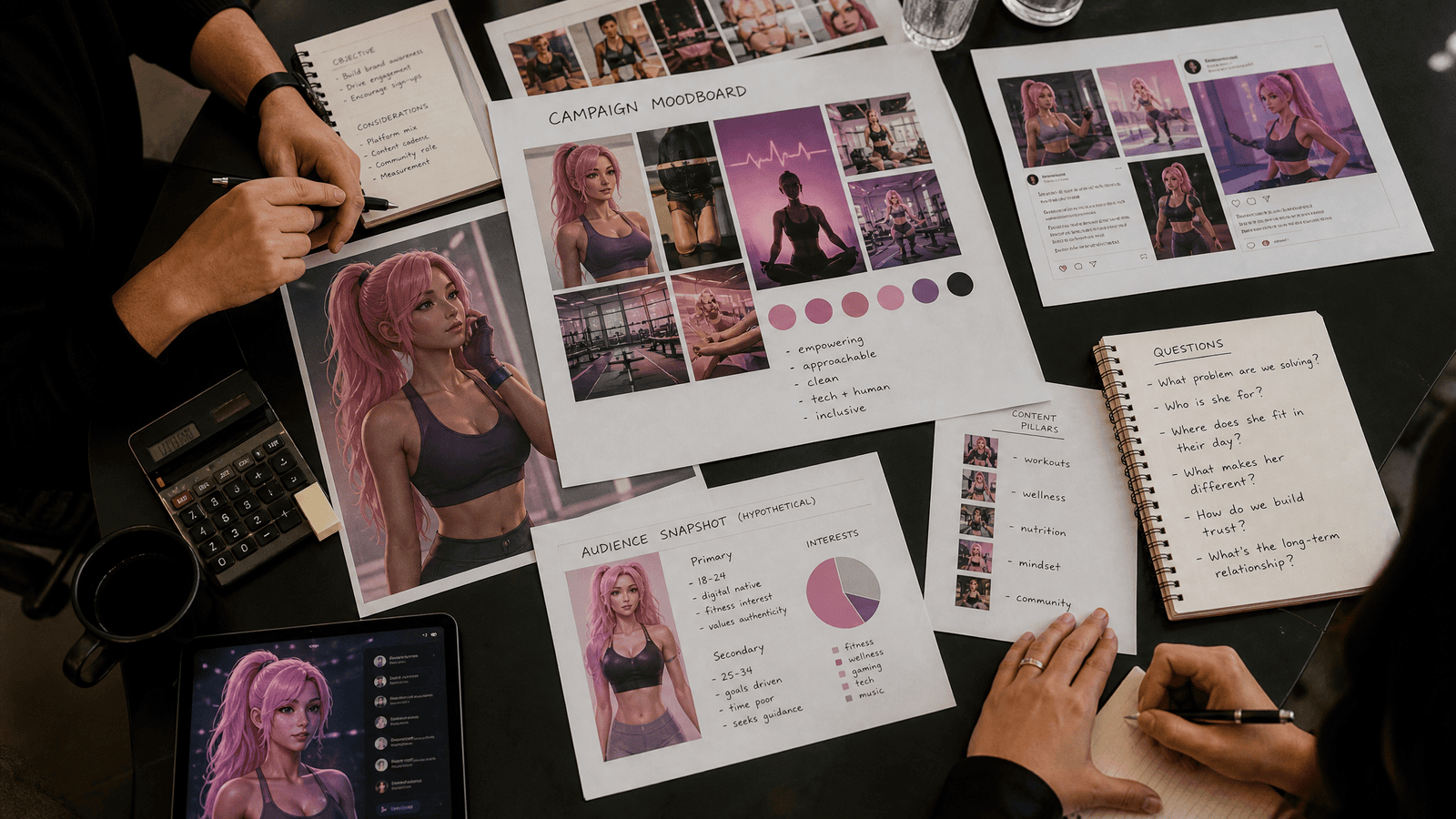
Aitana López is a virtual influencer created by the Spanish agency The Clueless. Her pink hair and fitness-focused identity made the character easy to recognize, but the more useful lesson is operational: a human team plans the story, creates the images, reviews the output, and manages commercial relationships.
That distinction gets lost when Aitana is described as an autonomous model “earning money.” The character is the public-facing asset. The agency does the work.
What is publicly documented
The Clueless describes Aitana as a fully AI-generated Spanish influencer. The character is presented as a fitness and gaming personality from Barcelona with a distinctive pink-haired look.
In a 2024 interview, a project manager from the agency told TIME that the team spent roughly two months defining the character. The same report said Aitana could earn up to €10,000 in a month, with a more typical month around €3,000, mainly through clothing and jewelry brand work. Those are statements from the team, not independently audited accounts, and should be described as reported figures rather than guaranteed economics. Read the TIME profile.
Follower counts and campaign totals change. A durable case study should not turn a live social number into a permanent headline.
The character is specific enough to remember
Aitana is not merely “an attractive AI woman.” The project combines several repeatable cues:
- pink hair;
- an adult fitness persona;
- a Barcelona identity;
- a consistent stylized-realistic visual treatment;
- recurring interests and a planned social narrative.
None of those elements is complicated by itself. Together they make the character recognizable in a crowded feed.
The useful rule is to choose a few signals and repeat them with restraint. A character with twelve signature accessories, five niches, and a dramatic backstory becomes difficult to produce and harder to understand.
Aitana is an agency workflow, not a magic prompt
The public output suggests a process closer to an editorial studio than a one-click generator.
Planning
The team decides what the character is doing, where the fictional scene takes place, and how it fits the ongoing persona. This creates continuity between posts.
Production
Artists generate and edit images until the face, body, hair, clothing, and environment meet the brief. The work is selected, not merely produced.
Publishing
Captions, replies, and posting decisions are handled by people. The audience interacts with a fictional character through a real operating team.
Commercial work
The agency negotiates with brands, defines deliverables, manages approvals, and handles rights. The character does not remove the normal work of client service.
If you are building your own production system, the consistent character guide is a better starting point than trying to reverse-engineer a single portrait.
What creators should copy
A narrow brief
Fitness gives the team recurring settings, clothing, products, and conversations. The pink-haired identity makes those posts recognizable.
A character bible
Record appearance, apparent adult age, personality, vocabulary, interests, visual rules, disclosure language, and subjects the character will not address. A one-page guide prevents daily improvisation from turning into drift.
Editorial review
Keep a canonical portrait and a small reference set. Reject off-identity images even when they are attractive. Review hands, reflections, garment continuity, and accidental logos before publishing.
An actual team role for the account
Decide whether the project sells production services, licenses a character, distributes sponsored content, or does some combination. These are different offers with different rights and measurements.
What not to copy
The headline income number
“Up to” describes a high point, not the normal result. New projects should budget from their costs and signed work, not from a press anecdote.
The surface aesthetic
Copying pink hair, fitness poses, or the name structure creates a weaker imitation and may create brand or likeness problems. Copy the discipline behind the project, not its recognizable expression.
The stereotype
The AI-influencer category often narrows women into the same young, sexualized, highly polished body type. TIME reported criticism of that pattern and noted the agency's stated effort to create a wider range of virtual models. A new project has room to represent different adult ages, bodies, cultures, jobs, and visual styles.
Ambiguous disclosure
Do not make the audience hunt for evidence that a character is virtual. Put plain disclosure in the profile and follow current platform labeling rules for generated and sponsored media.
A practical exercise inspired by the case
Build a one-week prototype before opening a public account.
- Write a one-sentence audience promise.
- Choose three visual cues and three character interests.
- Create six rights-cleared reference images.
- Produce a three-post sequence in one setting.
- Write captions that offer a real observation without inventing personal experience.
- Add clear virtual-character disclosure.
- Ask five people what they remember after one viewing.
If everyone remembers only the hair color, the concept needs more substance. If they can describe who the account is for and what it talks about, the character is beginning to work.
Frequently asked questions
Is Aitana López a real person?
No. She is a fictional virtual influencer created and operated by The Clueless, a human agency team.
Does Aitana really earn €10,000 every month?
The agency told TIME that earnings could reach that level in a strong month and that a more typical month was lower. The figures are reported claims, not a promise or a benchmark for new accounts.
What makes the project successful?
Recognizable art direction, a planned persona, consistent production, public attention, and agency sales work all matter. Reducing the result to image generation misses most of the operation.
Can I create a similar virtual influencer?
You can build an original character with a similar production discipline. Do not copy Aitana's name, likeness, visual identity, or brand assets.
What is the main lesson?
Treat a virtual influencer as an editorial and commercial system run by people. The image model is one part of that system, not the business itself.