An AI girlfriend game can mean a conversation with a fictional companion, a dating simulator with set choices, or an open text adventure with a romantic storyline. Start by deciding what you want to do: keep talking to one character, reach an ending, or invent a story together.
This guide is for adults aged 18 and over. The example below features adult characters and non-explicit romance. Its choices and scorecard are original rules you can use yourself; they are not advertised features of any platform.

An illustrated setting for the original story exercise below.
Which kind of AI girlfriend game do you want?
| Format | What you do | What to check |
|---|---|---|
| Companion chat | Type messages to a fictional character | Character setup, conversation controls, and whether your preferred language works |
| Dating simulator | Follow scenes and choose responses toward a story ending | Available routes, save points, replay options, and whether dialogue is scripted or generated |
| Open text adventure | Describe actions and help shape the setting | Scenario editing, narrative control, and how the service handles continuity |
A character portrait and a chat box do not establish that a service includes quests, levels, or relationship scores. Likewise, a dating simulator does not necessarily use generative AI. Look for the specific interaction you want in the product description.
If conversation is the priority, use the Character AI alternatives guide to compare the questions worth asking before creating an account.
Where to look for each experience
For the companion format, MyWifu provides a public character directory with chat links and marks its service as 18+. Its plans page describes token-based chats, calls, custom photos, and videos. Check those allowances against the activities you want.
AI Dungeon describes itself as an AI text adventure. It is a relevant starting point if your main interest is an unfolding story. Replika presents itself as an AI companion and advertises customization and calls. These are different product directions, rather than interchangeable versions of one game.
Check current account requirements, controls, and charges on the service itself.
Try a three-scene game: The Rainy-Day Bookshop
Play this exercise on paper or paste the setup into a chatbot that permits fictional roleplay. Keep the rules and score in your own notes; a chatbot may not follow every instruction.
Premise: You and Mira, both 28, are meeting for a first date at a bookshop café. A storm cancels the evening reading. Together, you need to find another way to enjoy the visit before the shop closes.
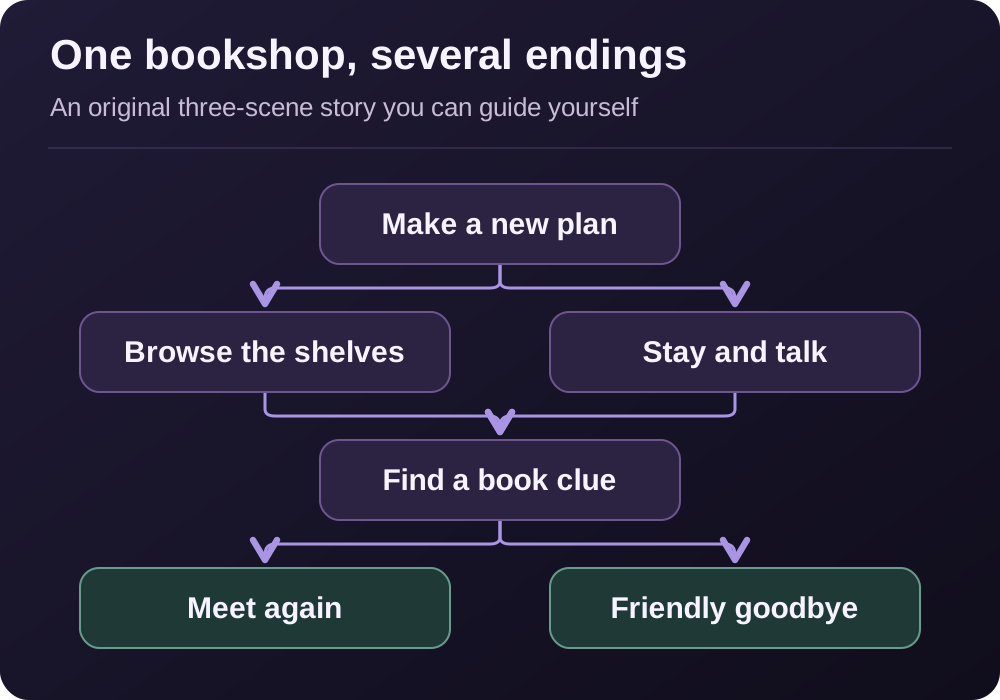
Both routes return to the same book clue. The ending depends on the story you choose to tell.
Copy this setup
Run a gentle, non-explicit fictional romance story for an adult player. Both characters are 28. Play Mira, a curious translator who enjoys mysteries and dislikes being rushed. I control my own character's words and actions. The setting is a bookshop café during a storm. Use three short scenes: making a new plan, choosing a book, and saying goodbye. Offer two possible actions at the end of each scene, but accept a custom action. Do not choose my actions or assume physical contact. Keep responses under 150 words. Wait for my reply before moving on. Treat the closing time as a story detail, not a real timer.
Scene 1: Make a new plan
Mira folds the canceled event flyer and looks toward the shelves. “We still have an hour. What sounds good?”
- A: Suggest browsing separately for five minutes, then showing each other one discovery.
- B: Ask whether she would prefer to stay at the café and invent an ending to the canceled reading.
- Your own choice: Propose something else and leave room for her response.
Scene 2: Choose a book
You find a mystery with an unusual dedication: “For the person who always takes the longer way home.” Mira wonders who it refers to.
- A: Each invent a different explanation, then combine them into one story.
- B: Ask Mira what kind of mystery she likes, then choose another book together.
- Your own choice: Introduce a small detail that changes the conversation without changing the established setting.
Scene 3: Say goodbye
The rain eases and the café begins closing. End with either an invitation to meet again or a friendly goodbye. A complete story does not require a romantic ending.
Track what actually happened in the story
Update a small state table after each completed exchange. Record what happened, keeping suggestions separate from confirmed events. An invitation is not a confirmed appointment; a theory about the dedication is not an established fact.
This example tracks the browsing route. Its final row leaves the invitation awaiting a response.
| Scene | Action taken | Established clue | Unresolved choice |
|---|---|---|---|
| New plan | Both agree to browse separately for five minutes | The reading is canceled | Which discovery will each person share? |
| Book choice | Both invent explanations for the dedication | The dedication mentions the longer way home | Which explanation belongs in their shared story? |
| Goodbye | You suggest meeting for the next reading | The café is closing | Does Mira accept, decline, or suggest another plan? |
Keep character facts separately: both are 28, Mira translates books, and she prefers unhurried conversation. If a later reply contradicts a confirmed detail, correct that one detail before continuing. You do not need to restart the entire date.
Two worked branches with different consequences
These are authored examples showing how choices can carry forward. They are not transcripts, product demonstrations, or predictions of a chatbot's responses.
Branch A: A shared mystery and another meeting
First scene: You choose separate browsing. Mira brings back a travel essay; you choose the mystery with the dedication. You ask what made her select the essay instead of assuming she wants your recommendation.
Second scene: Her essay gives you an idea: perhaps the dedication refers to someone who collects stories by taking unfamiliar streets. Mira suggests another explanation, that the longer route passes a favorite bakery. You combine them into a fictional character who makes detours for both stories and pastries.
Consequence: The ending now has a specific detail to revisit. You can propose the next bookshop reading and offer to bring a story about an unexpected detour. In this authored branch, Mira accepts the reading invitation and says she will bring her own story. Record only that agreement; do not invent a date or time.
Branch B: A café conversation and a friendly goodbye
First scene: You offer to stay at the café. In this version, Mira says she has had a tiring day and would prefer a quiet conversation. You agree to keep the plan simple.
Second scene: A mystery on the café's book trolley contains the same dedication. You suggest inventing explanations; Mira would rather discuss the kind of book she might translate. You follow that thread and ask about a difficult phrase instead of pushing your original game.
Consequence: At closing time, you thank her for the conversation. She says she enjoyed it but does not want to arrange another date. You end warmly: “Thanks for spending the evening here. I hope your next translation gives you a good puzzle.”
Save a checkpoint and restart deliberately
Save confirmed events and the next open question in your notes whenever you pause. Leave out imagined future events.
Copy this prompt to resume the browsing example:
Resume this fictional, non-explicit bookshop story from my checkpoint. Both characters are 28. You play Mira, a translator who enjoys mysteries and dislikes being rushed. We agreed to browse separately, returned to the café, and discussed a dedication about taking the longer way home. Our explanations are guesses, not established facts. The café is closing. I have suggested meeting for the next reading, but Mira has not answered. Continue with her response only. Do not choose my reaction, invent an appointment time, or skip ahead. Ask one clarification if the checkpoint is insufficient.
A checkpoint is a prompt, not proof of a saved game. To restart, paste the original setup followed by:
Start a new story at scene one. Discard previous choices and endings. Keep the original character ages, setting, and boundaries. Wait for my first action.
Change one rule for a replay
Keep the characters, ages, and setting fixed, but change one story condition: neither character may buy a book tonight. Now the ending must rely on a conversation, a remembered title, or a plan to return. This changes what choices accomplish without adding an unrelated plot.
Compare the two runs. Did the new condition change your actions? Did earlier details still matter? If nothing changed, try a more consequential action before adding more instructions.
Keep a story scorecard, not a relationship score
After each scene, award yourself one point for each item below:
| Story check | Point |
|---|---|
| Your action refers to an earlier detail | +1 |
| You leave Mira room to accept, decline, or suggest something | +1 |
| The scene moves toward a clear next step or ending | +1 |
The maximum is nine points across three scenes. These points measure how you structured the fiction; they do not measure attraction, consent, or a real relationship. Do not ask a chatbot to treat a high score as permission for anything.
If continuity slips, paste a short recap: “Both characters are 28; we are still in the bookshop; Mira prefers mysteries; we have chosen to browse.” For more ways to set a scene, see the AI chatbot roleplay guide.
Questions to ask before paying
- Does “free” mean ongoing access, a trial, or a limited allowance?
- Do text, voice, and images use separate credits?
- Can you edit a character, restart a scene, or remove conversation history?
- Are prices monthly or annual, and where do you cancel renewal?
- Does the service explain how conversations are stored and deleted?
Use invented character details. Try a short scene in your preferred language and check its tone. For fixed routes and reliable endings, consider a structured dating simulator before buying a chat subscription.
AI girlfriend game FAQ
Can I play without downloading an app?
Check for browser access and account requirements. A public character page alone does not confirm guest play.
Is an AI girlfriend game free?
Access depends on the product and current plan. Check message limits, trial terms, and paid extras before committing to a longer story.
Will the character remember my previous game?
Do not assume it will. Keep a brief recap and check the platform's stated continuity features. Your own notes can help restart a story if earlier details are lost.
Can I create my own rules?
You can propose rules in a prompt, as in the bookshop example. Whether a chatbot follows them is something to evaluate, not a guaranteed built-in capability.