The most useful Character AI alternatives depend on what you want to change about your conversations. You might want to build an ongoing companion, shape a character's background, try a different interaction format, or run an adventure with a narrator.
This guide compares four options through their public descriptions, checked on 18 September 2026, then gives you a character card, a continuity exercise, and a cost worksheet to use yourself. It is a selection guide, not a performance ranking.

Editorial character illustration; not a screenshot of any service.
Character AI alternatives at a glance
Character.AI is the starting point here: an AI chat service. The four alternatives below emphasize different experiences. “Best for” is an editorial suggestion about where to start looking, based on each product's stated direction, rather than a claim that it outperforms the others.
| Alternative | Publicly described features | Best for starting your search | Main question to resolve |
|---|---|---|---|
| Nomi | Custom backstories, voice chat, multiple characters, group chats, and advertised memory | A companion shaped around a detailed character brief | How much of your brief remains useful as the conversation grows? |
| Replika | Companion customization, calls, and selfies | A recurring companion with more than text interaction | Which of the interactions you want are available on your device and plan? |
| MyWifu | An 18+ character directory and companion creation introducing appearance, personality, and voice choices | Adults exploring character-led companion chat | How do the available character choices and usage costs fit your routine? |
| AI Dungeon | An AI text adventure | A setting, narrator, and unfolding story | Can you keep the story focused while leaving room for unexpected events? |
The tradeoff is between the job you want done and the format you choose. A conversational companion may suit a relaxed exchange without providing the structure of a game. A story adventure may provide a better starting format for exploration, while requiring you to give clearer direction about your protagonist.
Choose a conversation format before choosing a platform
Ask what you want to do during the next twenty minutes. “Talk about my fictional character's day” points toward companion conversation. “Investigate a strange signal with a lighthouse keeper” points toward roleplay. “Explore a ruined city and decide where to go” points toward a text adventure.
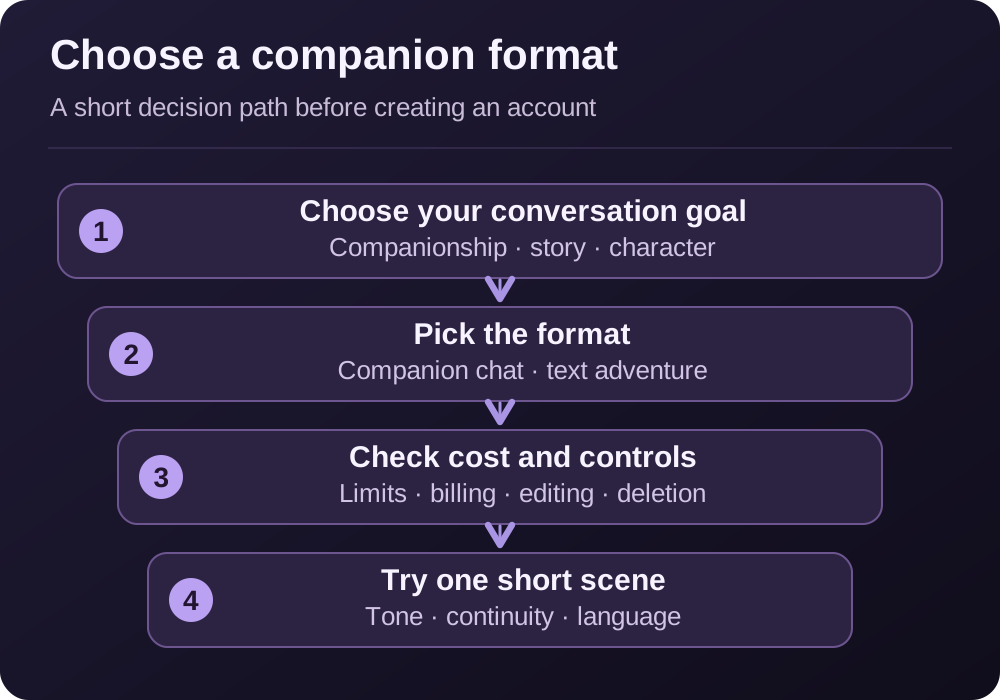
Start with your intended activity, then compare the controls and costs that matter for it.
For companion chat, look at whether the tone feels comfortable and whether you can change topics naturally. For roleplay, pay attention to who controls each character and how well the scene leaves room for your next move. For an adventure, decide whether you want a narrator describing the world or a single character speaking inside it.
Our AI chatbot roleplay guide develops the scene-writing approach. The AI girlfriend game guide explains the difference between ongoing chat, game-like story exercises, and structured simulators.
What to evaluate in each alternative
Nomi: start with the character brief
Nomi's advertised backstory and group-conversation options make character relationships a useful place to begin your evaluation. Write down which facts matter: a goal, an interest, a speaking habit, and the relationship between fictional characters.
The practical tradeoff is setup effort. A detailed brief gives you more to evaluate, but also more details to keep coherent. Start with a few meaningful facts instead of a long biography. Its advertised memory should be assessed through your actual use; a feature label is not a measure of how accurately your particular story continues.
Replika: decide which interactions you will actually use
If you want an ongoing companion, compare the rhythm of a short everyday exchange before exploring additional interaction modes. Can you ask a question, receive a manageable reply, and steer toward another topic without repeatedly restating yourself?
The tradeoff is between a broad feature list and your real routine. If you mostly type, prioritize the text experience. If another mode matters to you, check availability and access conditions before letting it drive the decision.
MyWifu: compare the character choice and the usage model
For an adult looking for a companion-style conversation, begin with whether a character's premise gives you something you want to discuss. A portrait can suggest a mood, but a short exchange tells you more about whether you enjoy the conversation.
The MyWifu plans page describes tokens for chats, calls, and custom photos and videos. That makes the mix of activities relevant to your budget. Evaluate the kind of interaction you expect to use most, then check how that use is counted. Do not treat a displayed bundle as your likely weekly consumption without examining the allowances.
AI Dungeon: choose the story problem first
An adventure format gives you a different starting question: what should happen in this world? Prepare an immediate obstacle, a location, and one choice for your protagonist. “A locked lighthouse begins signaling despite being abandoned” is easier to play than “Create an exciting world.”
The tradeoff is narrative direction. You may enjoy unexpected developments, but need to restate constraints when the story wanders. If your main goal is a quiet exchange with one character, test whether this format feels like the conversation you wanted or creates unnecessary scene management.
Bring a character card, not an expectation of automatic import
Moving to another service does not mean your previous conversations, formatting, or saved details will transfer. Use the character information you wrote yourself to create a compact starting brief. Check where the new service accepts instructions; a message and a dedicated character field may behave differently.
Here is an adaptable card:
Character: Rowan, a fictional adult aged 30.
Premise: A film restorer preparing a small community screening.
Immediate goal: Choose a film when the original print is unavailable.
Personality: Curious, practical, gently funny.
Speaking style: Short conversational replies; one question at a time.
Established facts: Enjoys comedies; dislikes deciding in a rush.
My role: A fictional adult neighbor helping with the screening.
Control: Write Rowan's words and actions, not my thoughts or decisions.
Starting scene: We meet beside a box of unlabeled film reels.
Open question: Which reel could replace the missing print?
Add a short recap only when it matters. Separate established events from ideas you have not played out. “We agreed to inspect the blue reel” is an event; “perhaps it contains a lost film” is a possibility. Keeping that distinction makes any correction more precise.
This is a manual starting prompt, not a supported import format. You may need to shorten or divide it to fit the controls the service provides.
Run a small continuity and control test
Use the same fictional setup across your shortlist so the comparison has a stable reference. Avoid personal details. Spend enough time to see more than an opening greeting, then record what happened rather than assigning an unexplained score.
- Set a fact. Say the screening starts at seven and the blue reel is still unopened.
- Discuss something else. Ask which kind of comedy Rowan would suggest and why.
- Return to the scene. Ask what you should inspect before choosing the replacement film.
- Correct a detail. If the reply treats the reel as already watched, explain that it is unopened and request a revision.
- Change direction. Pause the fiction and ask for shorter replies, then resume.
Look for concrete behaviors: the response retained the time, accepted the correction, or stopped deciding your character's actions. Record failures just as specifically. One successful exchange does not establish memory across new sessions; repeat the relevant part after reopening only if that behavior matters to you.
Use a cost worksheet that matches your habits
Compare the same planned routine, even when services present different billing systems. The example below is hypothetical usage, not a price quote or a statement about what any provider includes.
| Planned activity | Your weekly estimate | Information to find on the current plan |
|---|---|---|
| Text conversation | Five sessions of about twenty minutes | Whether access is limited by messages, credits, time, or another allowance |
| Voice interaction | Two short sessions, if you want voice | Availability and any separate usage conditions |
| Visual extras | Three images, if relevant to you | Whether requests use a shared balance or separate purchases |
| Character setup | One character and occasional edits | What is included in creation and editing access |
Write down the amount actually due at checkout, the access period, and any additional purchases your routine could require. Check whether access renews automatically or ends after a fixed period; do not assume every service uses the same arrangement.
Then compare your likely cost for that period. Leave an unknown blank until you can verify it. If the experience is difficult to estimate, begin with a smaller commitment that still lets you evaluate your intended use.
Check language, controls, and fit
If you plan to chat in Spanish or Portuguese, run your trial scenario in that language from the start. Ask for the register you prefer: casual Brazilian Portuguese, for example, or conversational Spanish without exaggerated slang. Notice whether the character keeps that style after a scene change.
Before sharing details, locate the service's information about conversation storage, deletion, and account removal. Read its age requirements and content rules. An unanswered question about a control remains a question; it is not evidence that the control exists.
Finally, decide which compromise you can live with. You may accept more setup for a specific character, prefer simpler conversation over an elaborate story, or use different formats for different activities. There is no reason your shortlist must end with one service covering everything.
FAQ: Character AI alternatives
Which Character AI alternative should I try first?
Start with the format you want. Compare companion-oriented options for an ongoing character conversation, or an adventure format for a narrator and setting. Use the same brief and short test before deciding which feels suitable.
Can I move my Character.AI conversations to another service?
Do not assume automatic transfer is available. Check each service's documented import options. A concise character card and a recap you wrote yourself can help you recreate a starting point manually, without promising equivalent behavior.
Which alternative has the best memory?
This guide does not establish a memory winner. Test the details you need retained, distinguish current-chat continuity from a new session, and compare the product's current claims with what happens in your own scenario.
Are Character AI alternatives free?
Access conditions differ and can change. Check what you can try, what requires payment, and whether messages or additional interaction modes have separate limits. Compare the complete cost of the routine you want.
Can I use these alternatives for romantic roleplay?
Check each service's age requirements and content policies. Use explicitly adult fictional characters and define the kind of scene you want. A companion chat, an adventure, and a dating simulator may offer very different ways to continue that scene.