There are creators right now running three, four, even five Instagram channels simultaneously. They have never stood in front of a camera. They have never recorded a voiceover in their bedroom. They have never spent 45 minutes trying to get the lighting right for a single reel.
They are making more content in a single week than most creators produce in months — and landing sponsorships on accounts that are 100% AI-generated.

This is not hypothetical. One creator built a personal brand on Instagram in February 2025 without ever recording anything. First sponsorship by month four. Hit 100K followers by month ten. Now sitting at 159K with sponsorship rates that would make traditional creators furious.
The system behind it is not magic. It is a repeatable workflow that anyone can set up — and the window to do it is wide open right now.
Automate the video side to hit volume
Why Most AI Content Screams "AI Made This"
Before you touch a single AI tool, you need to understand what you are fighting against.
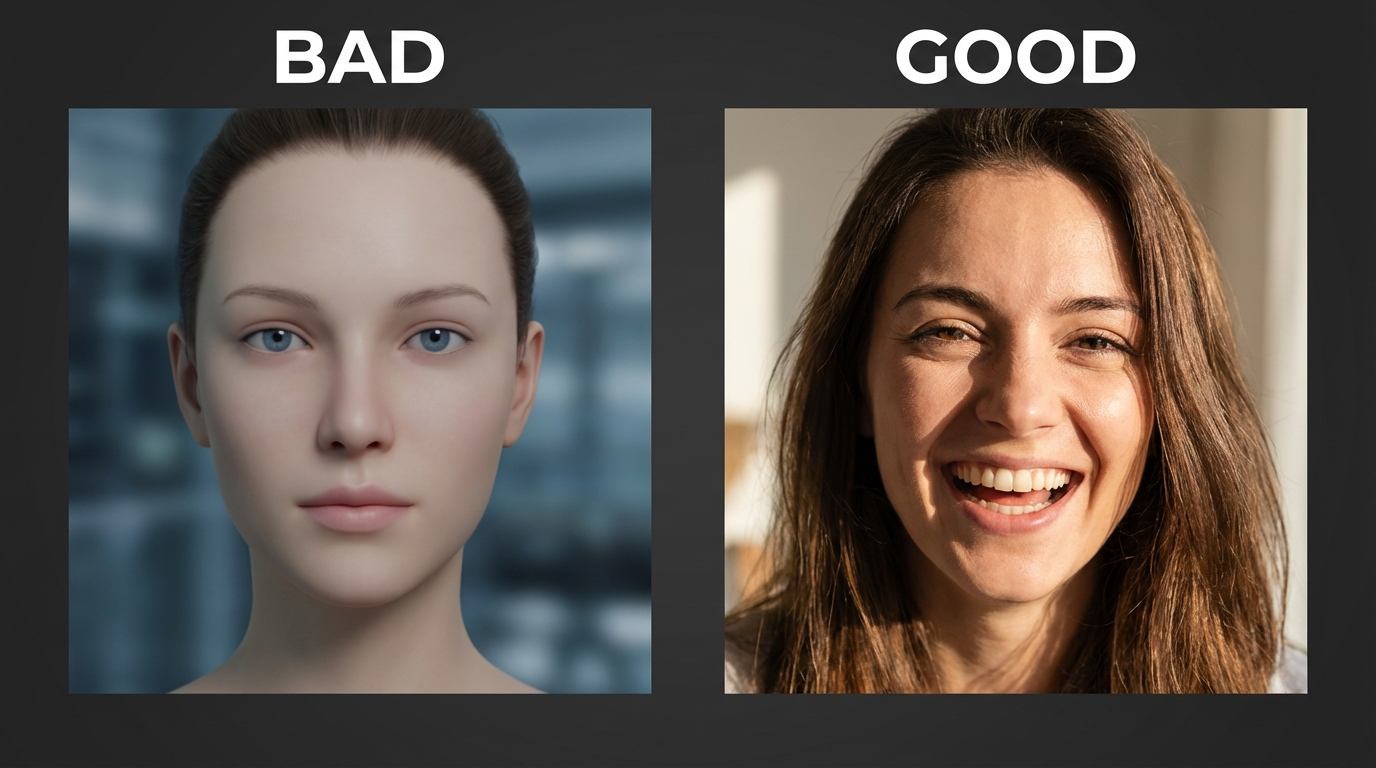
Open Instagram right now. Scroll for sixty seconds. You will spot the AI slop instantly: plastic skin with zero pores, dead eyes that look through you instead of at you, movements that feel like an animated mannequin, shadowless scenes that look like they were rendered inside a lightbox, and voices that sound over-enthusiastic in a way no real person ever talks.
That is what happens when someone types "make a video of a person talking about fitness" into a tool and hits generate without any thought behind it.
Input equals output. This is the single most important concept in AI content creation, and most people do not take it seriously enough.
The Input-Output Law of AI Content
If you feed AI a blurry selfie taken in bad lighting, it will produce blurry content that looks nothing like a real person. If you give it a properly lit, high-resolution reference with a clear face, natural expressions, and clean audio, it will produce something that genuinely passes as real. There are no shortcuts around this.
The Quality Markers That Separate Viral from Invisible
Every piece of content needs to pass these checks before it goes live:
- Skin texture: Are pores visible? Does the skin have natural variation — slight redness, subtle imperfections, visible texture? Or does it look like smoothed plastic?
- Eye contact and gaze: Do the eyes look alive? Is there depth in the iris? Do catchlights appear naturally from the lighting in the scene?
- Lighting consistency: Do shadows fall in the right direction? Does the light source in the scene make physical sense?
- Movement naturalness: In video, does the person move like a human or like a 3D model with motion capture applied? Small involuntary movements — swallowing, blinking irregularly, weight shifting — are what sell realism.
- Audio authenticity: Does the voice have natural cadence? Are there micro-pauses, breath sounds, slight pitch variations?
- Scene coherence: Does the background match the subject? Is the depth of field consistent with the apparent camera distance?
If a single one of these fails, the content gets scrolled past. Human perception is brutally good at detecting fakes, even when people cannot consciously articulate what feels off.
The Anatomy of AI Content That Actually Converts
There is a massive gap between AI content that gets views and AI content that gets followers, saves, shares, and sponsorship inquiries. Views are vanity. Conversion is revenue.
Here is what separates the two:
Content That Flops
- Generic prompts producing generic output — "a beautiful woman in a nice outfit"
- Same pose, same angle, same expression in every post
- Overprocessed images with unrealistic skin smoothing
- Scripts that sound like they were written by an AI summarizing a blog post
- Inconsistent character — the face shifts slightly between posts and viewers lose trust
- No hook in the first frame — the content looks like everything else on the feed
Content That Converts
- Hyper-specific prompts producing distinctive, recognizable output
- Varied compositions — close-ups, wide shots, overhead, low angle, candid moments
- Natural skin texture with imperfections that signal authenticity
- Scripts written in conversational voice with genuine opinions and personality
- Perfectly consistent character that viewers recognize instantly as "their" creator
- Strong hook in the first 0.5 seconds — pattern interruption that stops the scroll
The technical quality of AI tools in 2026 is good enough to produce either outcome. The difference is entirely in how you use them.
The Save Rate Metric
Instagram's algorithm weighs saves more heavily than likes or comments. Content that gets saved signals high value. For faceless AI channels, educational carousels, tip-based reels, and "how I did X" content consistently achieve the highest save rates. Optimize for saves, not likes.
The Tool Stack: Right Model for Each Job
Using one AI tool for everything is the fastest way to produce mediocre content. Each model has a strength, and trying to force it into a role it was not built for wastes your time, your credits, and your money.
Here is how a professional faceless Instagram workflow is structured:
Character Creation
Nano Banana Pro for photorealistic faces. One prompt generates a unique face indistinguishable from real.
Image Editing
Qwen 2.0 Pro Edit for outfit changes, background swaps, and scene modifications without regenerating.
Short-Form Video
Kling v3.0 and Seedance for reels — human-like motion, facial expressions, and natural movement.
Talking Videos
Lip Sync for up to 10-minute speaking videos. Clone any voice with natural cadence and emotion.
Cinematic B-Roll
Sora 2 and Veo 3.1 for cinematic content — transitions, lifestyle scenes, and brand storytelling.
Rapid Iteration
WAN 2.6 Flash for fast drafts and variations. Test ideas at 3,000 credits/sec before committing to premium models.
The Tool Matching Framework
| Content Type | Best Model | Why |
|---|---|---|
| Profile photos and hero shots | Nano Banana Pro | Unmatched photorealism, natural skin texture, consistent character |
| Instagram Reels (talking head) | Lip Sync + Kling v3.0 | Natural lip movement up to 10 minutes, realistic expressions |
| Instagram Reels (cinematic) | Sora 2 / Veo 3.1 | Cinematic camera movements, automatic audio, film-quality output |
| Stories and quick content | WAN 2.6 Flash | Fast generation, low cost, perfect for ephemeral content |
| Carousel images | Seedream 4.5 | Fast, consistent, great for batch generating related images |
| Outfit and scene variations | Qwen 2.0 Pro Edit | Edit existing images without full regeneration |
Stop trying to find the "perfect" model. Match the model to the task.
The Multi-Model Advantage
The biggest operational mistake new creators make is trying to do everything with one tool. A channel built entirely on one model's output develops a visual sameness that viewers notice subconsciously. By mixing models — Nano Banana Pro for hero images, Seedream for daily content, Kling for video, Sora for cinematic pieces — your content has natural visual variety while maintaining character consistency. Each model has a slightly different rendering character that keeps the feed feeling alive.
Budget Allocation Across Models
For a faceless Instagram channel posting 14 times per week, here is how credits typically break down:
| Content Type | Weekly Volume | Model | Credits Per Piece | Weekly Credits |
|---|---|---|---|---|
| Hero images | 3 | Nano Banana Pro | 14 | 42 |
| Daily content images | 7 | Seedream 4.5 | 5 | 35 |
| Talking head reels | 3 | Lip Sync (30s) | ~90 | 270 |
| Cinematic reels | 1 | Kling v3.0 Std (5s) | 20 | 20 |
| Total | 14 | ~367,000 credits/week |
On the Pro plan ($24.99/month), this production schedule fits comfortably within your monthly credit allocation.
Prompting Like a $500/hr Creative Director
The biggest unlock in faceless AI content is changing how you think about the interaction with AI models.
You cannot type something vague and receive magic.
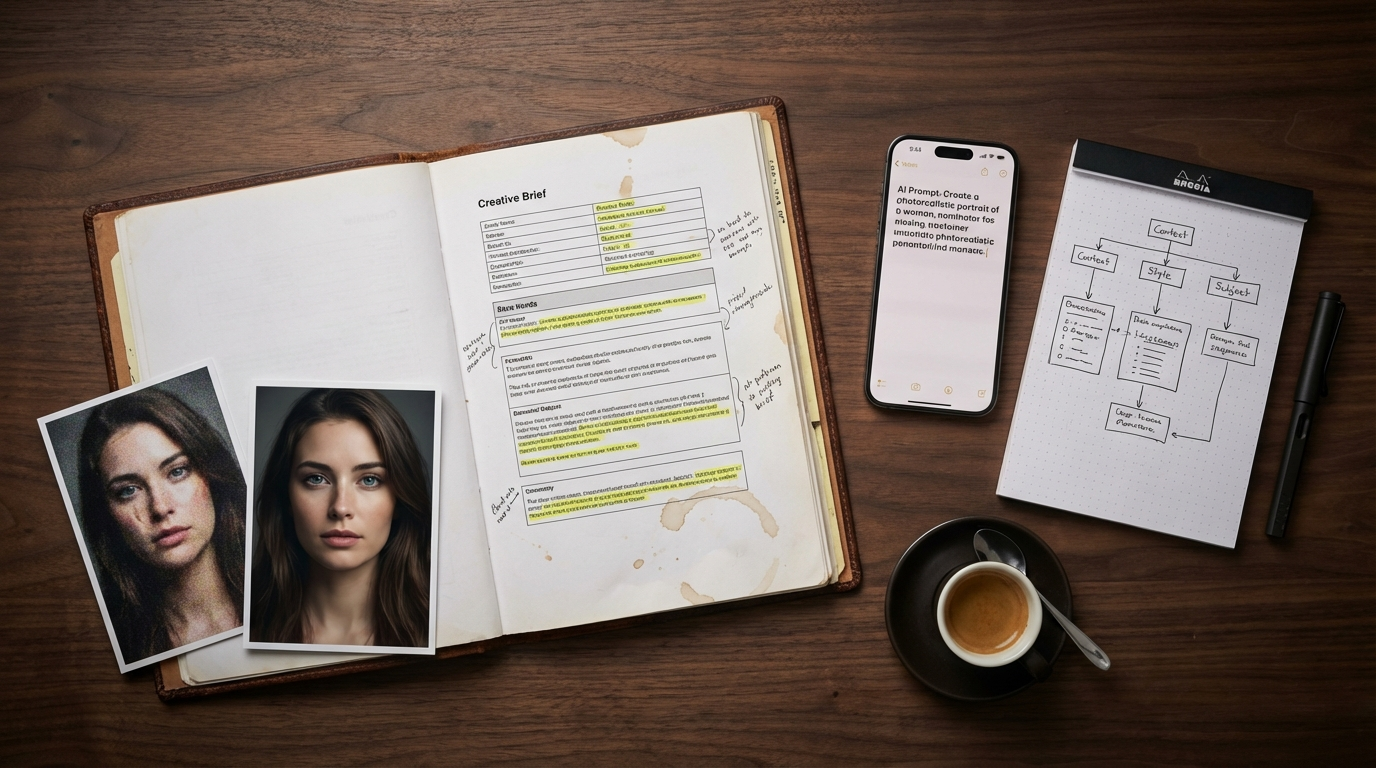
Imagine you hired a senior creative director at $500 per hour. You would never walk in and say "make a video." You would show up with a detailed brief: deliverables, visual references, what it should look like, what it absolutely should not look like, tone, length, format, target audience, and desired emotional response.
That is exactly how you need to communicate with AI models. The gap between a one-line prompt and a proper brief is the gap between content that gets zero views and content that gets 10 million.
The Brief Framework for Cinematic Content
When prompting for video or image content, specify all of these: specific scenario (not "a cool scene"), camera angle (eye-level, low angle, overhead), background details (what is in the frame besides the subject), lighting type (golden hour, studio softbox, neon), lens and camera settings (85mm f/1.4 for portraits, 24mm for wide establishing shots), subject movement (how the person moves, gestures, expressions), and what to avoid (no text, no watermark, no plastic skin).
Bad Prompt vs. Good Prompt
Bad prompt:
A woman talking about skincare in her bathroom
Good prompt:
A 24-year-old woman with honey-brown hair in a messy bun, wearing a
white cotton tank top, standing in a modern marble bathroom with warm
vanity lighting. She is holding a small glass serum bottle and applying
it to her cheek with her fingertips. Natural morning light from a
frosted window to the left. Visible skin texture: slight redness on
cheeks, natural pores, no visible makeup. Expression: relaxed, genuine
smile, speaking casually to camera. Shot on iPhone 15 Pro, portrait
mode, f/1.78, warm color grading. Bathroom details: white subway tile,
gold fixtures, small potted eucalyptus plant, soft white towel folded
on counter. No text, no watermark.
The second prompt gives the model enough information to produce something that could pass as a real person's Instagram story. The first produces generic AI slop.
The Content System: 80/20 Rule
There is a critical distinction in content strategy that most AI creators miss.
Some of the best content creators in the world produce a small number of extremely high-quality pieces. One YouTube creator made 23 videos — each taking 1,000 hours — and gained 1.5 million subscribers. That approach is incredible but it does not work for the vast majority of people. You do not have 1,000 hours per video. You do not have a team of animators and editors.
For faceless Instagram channels, quantity and reps matter more than perfection — especially in the beginning.
Here is why: volume teaches you what hooks land, what thumbnails get clicked, how to batch winners, and builds the pattern recognition that eventually lets you produce consistently good content. You cannot learn these lessons from theory. You learn them from publishing 150 pieces and seeing what sticks.
The 80/20 Content Split
80% Proven Formats
Study what is working in your niche right now. Use competitor analysis to find videos with outlier performance. Analyze hook structures, video length, and format. Then recreate these formats with your AI character.
20% Experimental
Test new hooks, new content types, new visual styles. Try different video lengths. Experiment with trending audio. Push creative boundaries. This is where you discover the next format that will carry your channel.
Measure and Iterate
After 2-3 weeks of posting, analyze what performed. Double down on winners. Kill formats that consistently underperform. Move successful experiments into the 80% proven category.
Scale What Works
Once you find a winning format, produce 10-20 variations. Change the hook, change the outfit, change the setting — keep the core structure. This is where AI speed becomes an unfair advantage.
Trial and error with AI tools is absurdly fast and cheap compared to traditional content creation. You can regenerate a video nine times until you get the exact output you want — and it takes twenty minutes total, not twenty days.
The Weekly Content Calendar
For a faceless Instagram channel posting twice daily (which is what the 130K account runs):
| Day | Morning Post | Evening Post |
|---|---|---|
| Monday | Talking head reel (niche tip) | Lifestyle image carousel |
| Tuesday | Cinematic B-roll reel | Story-style quick tip |
| Wednesday | Product/brand integration | Behind-the-scenes style content |
| Thursday | Talking head reel (trending topic) | Outfit/aesthetic showcase |
| Friday | High-effort cinematic reel | Engagement bait (poll, question) |
| Saturday | Carousel (educational) | Lifestyle reel |
| Sunday | Batch plan next week | Recap or motivational content |
That is 14 reels per week. With a manual workflow, you would spend roughly 14 hours filming and editing. With AI, the entire batch can be produced in a single afternoon.
The Time Economics
Recording a reel manually takes approximately 45 minutes including setup, filming, and editing. At 14 reels per week, that is 10.5 hours of production time. An AI workflow producing the same 14 reels takes 2-3 hours total. That is 7-8 hours per week freed up — time you can spend on strategy, engagement, or scaling additional channels.
Building Your Faceless Instagram: Step-by-Step
Here is the exact system for launching a faceless Instagram channel using MakeInfluencer.ai. This is the same methodology that creators use to build six-figure accounts without ever appearing on camera. Every step has been tested across multiple niches — fashion, fitness, lifestyle, tech, food, and finance — and the framework translates across all of them.
Phase 1: Character Creation
Your AI character is the foundation of your entire channel. Spend time here — everything else builds on this.
Generate Your Character's Face
Use Nano Banana Pro to generate a unique, photorealistic face. Write a detailed prompt specifying ethnicity, age, hair color and style, facial features, and expression. Generate 5-10 variations and pick the one that feels most authentic and appealing for your target niche.
Build a Reference Library
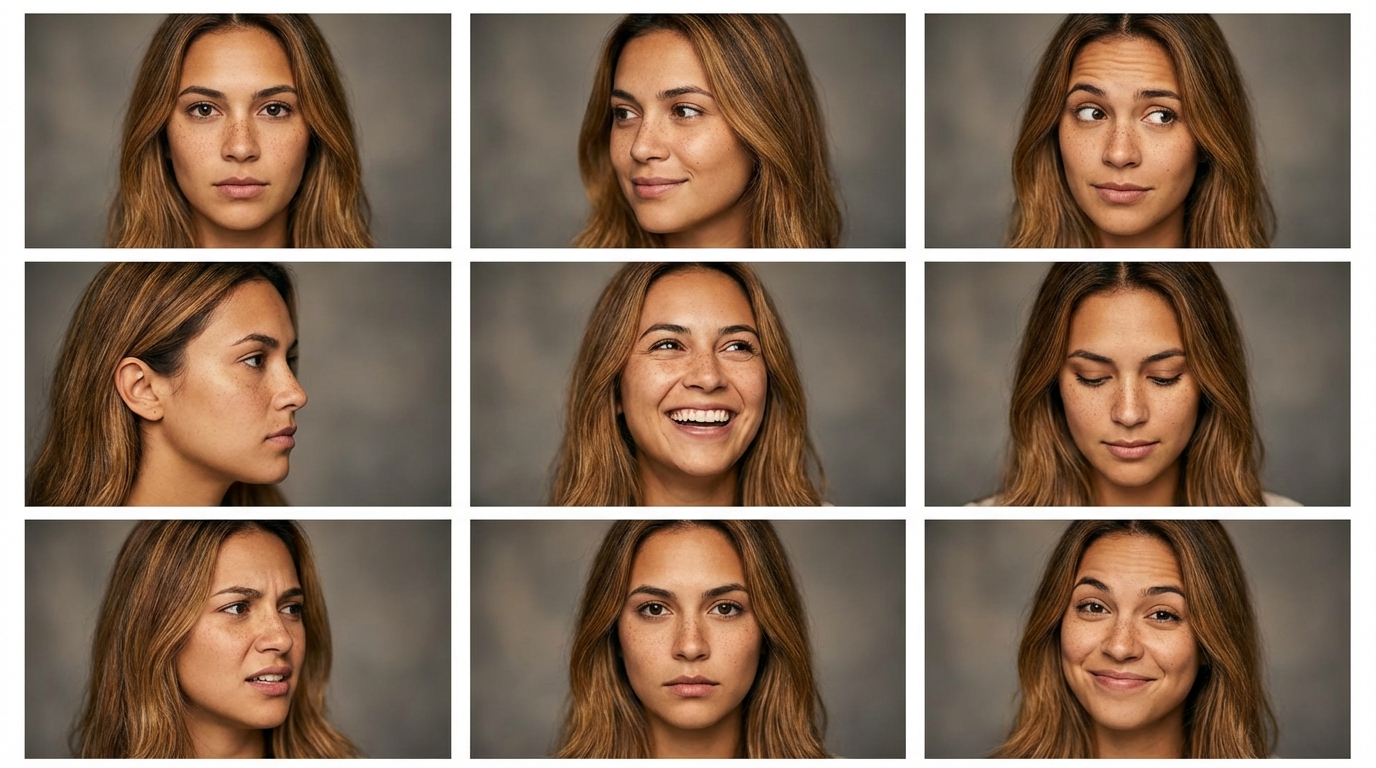
Once you have your character's face, generate a 9-panel reference grid showing them from multiple angles: front-facing, three-quarter left, three-quarter right, profile, looking up, looking down, laughing, serious, and candid. This ensures visual consistency across all future content.
Define the Character Identity
Create a detailed character sheet: name, age, location, personality traits, interests, communication style, wardrobe preferences, and backstory. This is not optional — it drives every content decision and keeps the channel feeling like a real person.
Generate Foundational Content
Produce 30-50 initial images across different poses, outfits, locations, and moods. This is your content bank. Use these as source images for video generation, story content, and establishing the character's visual identity on the grid.
Phase 2: Content Production Pipeline
Once your character exists, set up the production pipeline that will let you batch content efficiently.
Image Content Pipeline:
- Write prompts for 5-7 images at once (one batch = one week of static posts)
- Generate all images using Nano Banana Pro or Seedream 4.5
- Review each image against the quality markers checklist
- Edit any that need adjustments using Qwen 2.0 Pro Edit
- Export and organize by posting day
Video Content Pipeline:
- Write scripts for 4-7 talking head reels (batch the writing)
- Select source images for each video (character in appropriate setting)
- Generate lip sync videos using your character's cloned voice
- Generate 2-3 cinematic B-roll reels using Kling v3.0 or Sora 2
- Review all videos for quality markers
- Export and schedule
The key is batching. Do not create one piece of content at a time. Write all your scripts on Monday, generate all images on Tuesday, produce all videos on Wednesday. Batching keeps you in creative flow and maximizes efficiency with the AI tools.
Phase 3: Launch and Growth Strategy
Week 1-2: Soft Launch
- Post once per day to establish the algorithm's understanding of your content
- Use relevant hashtags (mix of large and niche-specific)
- Engage manually with accounts in your niche — like, comment, follow
- Do not expect viral content yet. You are training the algorithm.
Week 3-4: Ramp Up
- Increase to twice daily posting
- Start analyzing which posts perform best (save rate, share rate, comments)
- Double down on formats that show early traction
- Begin experimenting with trending audio and formats
Month 2-3: Optimize
- You should have enough data to identify your top-performing content types
- Build a repeatable template for your best formats
- Start batch-producing variations of winners
- Begin outreach for collaborations and cross-promotions
Month 4+: Monetize
- With consistent growth, sponsorship inquiries should start arriving
- Create a media kit showing your engagement rates and audience demographics
- Set sponsorship rates based on your follower count and engagement
- Explore additional revenue: affiliate links, digital products, cross-platform growth
Account Warming: Do Not Skip This
Before posting any content, spend 3-5 days behaving like a normal user on the account. Watch reels in your niche. Follow similar accounts. Like and comment on content. This tells the algorithm what your account is about and prevents the "cold start" problem that kills many new channels. Your first posts will reach more relevant people if the algorithm already understands your niche.
The Speed-to-Iteration Advantage
Here is what most people miss about AI content: the advantage is not just that it is cheaper or faster. The real advantage is iteration speed.
Traditional content creation has a feedback loop measured in weeks. You shoot a video, edit it, post it, wait for results, then decide what to try next. If the video flops, you have wasted days of work.
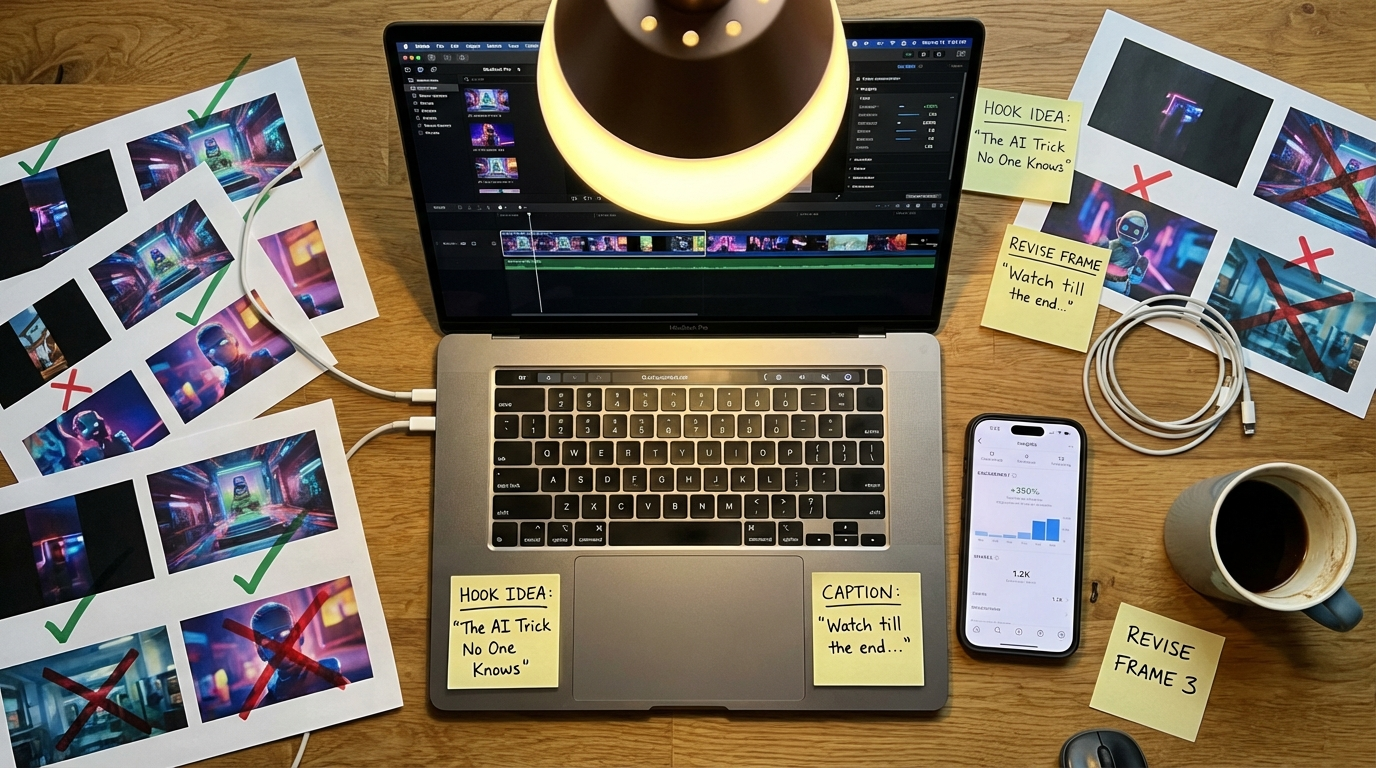
With AI, the feedback loop is measured in minutes. Generated a reel that does not look right? Regenerate it. Want to test a different hook? Produce a new version in fifteen minutes. Want to see how the same concept works with different visual styles? Generate five variations and A/B test them.
This speed advantage compounds. Over the course of a month, an AI creator runs 10x more experiments than a traditional creator. After three months, they have pattern recognition that would take a traditional creator a year to develop.
AI Content Production vs Traditional
Monetization: From Followers to Revenue
A faceless Instagram channel monetizes the same way a traditional channel does — but with significantly better margins because your production costs are near zero.
Sponsorships and Brand Deals
This is the primary revenue stream for most faceless channels. Brands care about three things: audience size, engagement rate, and niche relevance. They do not care whether the creator is AI-generated or real, as long as the audience is real and engaged.
Typical sponsorship rates for faceless AI channels:
- 10K-50K followers: $200-$800 per sponsored post
- 50K-100K followers: $800-$2,500 per sponsored post
- 100K-250K followers: $2,500-$8,000 per sponsored post
- 250K+ followers: $8,000-$25,000+ per sponsored post
Affiliate Marketing
The beauty of a faceless AI channel is that you can seamlessly integrate products into your character's lifestyle content. Generate images of your character using, wearing, or interacting with any product and post them alongside affiliate links.
The most profitable affiliate niches for faceless Instagram channels:
- Fashion and accessories: Generate your character wearing specific brands and link to them. Fashion affiliate commissions typically run 5-15% per sale.
- Beauty and skincare: Create routine-style content showing your character using products. Beauty affiliates earn 8-20% commissions.
- Tech and gadgets: Lifestyle images with your character using phones, headphones, laptops, and smart home devices. Tech affiliates earn 2-8%.
- Fitness equipment and supplements: Gym content with your character using specific products. Health affiliates earn 5-15%.
Include affiliate links in your bio, stories, and post captions. Product recommendation content is natural for lifestyle, fitness, fashion, and tech niches. With AI, you can generate product showcase content featuring your character with any product.
For a deeper dive into affiliate strategies, see our affiliate marketing with AI influencers guide.
Digital Products
Once you have an audience, you can sell what you know: prompt templates, content calendars, niche research, AI workflow guides. The meta-play of teaching others how to build faceless channels is itself a lucrative niche.
Cross-Platform Expansion
Your AI character is not limited to Instagram. The same content can be repurposed for TikTok, YouTube Shorts, and X. Each platform multiplies your reach without multiplying your production effort. See our guides on AI TikTok monetization and faceless YouTube channels.
MakeInfluencer.ai Plans for Faceless Channels
Common Mistakes That Kill Faceless Channels
After studying dozens of faceless AI accounts — both successful and failed — these are the patterns that consistently predict failure.
Mistake 1: Changing the Character
Some creators get bored with their character after a few weeks and start tweaking the appearance. Maybe the hair color changes, or they switch to a slightly different face. Every change resets the audience's familiarity. Commit to your character and stick with them.
Mistake 2: Posting Without a Hook Strategy
The first frame of every reel determines whether anyone watches. Yet most AI creators spend 90% of their effort on the content and 10% on the hook. Flip that ratio. Spend serious time studying hooks that work in your niche, then engineer your first frame to stop the scroll.
Mistake 3: Ignoring Comments and DMs
A faceless channel still needs engagement. Respond to comments. Reply to DMs. Ask questions in your captions. The algorithm rewards accounts that generate conversation, and a faceless channel that ignores its audience is a faceless channel that stops growing.
Mistake 4: Over-Producing and Under-Publishing
Some creators spend weeks perfecting a batch of content before posting any of it. Meanwhile, competitors are publishing daily and learning from real data. Launch imperfect content, learn from the metrics, and improve iteratively. Perfectionism is the enemy of growth.
Mistake 5: No Content Pillars
Posting random content with no thematic consistency confuses the algorithm and your audience. Define 3-4 content pillars — recurring themes or formats — and rotate between them. This gives the algorithm clear signals about your niche and gives your audience predictable value.
Example pillar structure for a fitness faceless channel:
- Pillar 1: Quick workout tips (talking head reels, 15-30 seconds)
- Pillar 2: Transformation/motivation content (cinematic reels with music)
- Pillar 3: Nutrition and meal prep (carousel images with detailed captions)
- Pillar 4: Product reviews and recommendations (UGC-style reels for affiliate revenue)
Each pillar serves a different purpose — engagement, inspiration, education, and monetization — while keeping the overall channel focused on fitness.
What AI Still Cannot Do For You
AI can systematize production, automate editing, replicate voice style and facial expressions, and build workflows that turn a single image into a full video. But it cannot automate the one thing that actually matters: the initial concept.
The ideas that make someone stop scrolling. The angles nobody else in your niche has thought of. The creative direction that makes someone screenshot your reel and send it to their group chat. That spark comes from you — from studying your niche obsessively, understanding what your audience cares about, and combining ideas in ways that feel fresh.
The creative director is the most valuable role in the AI content space right now. Models can execute almost anything you can imagine, create, and describe. But without that initial spark, average content stays average no matter how good the AI is.
The Creative Director Mindset
Spend at least 30 minutes per day consuming content in your niche — not passively scrolling, but actively analyzing. What hooks stopped you? What made you watch to the end? What made you tap through a story? Reverse-engineer the winners, then adapt the underlying patterns to your channel with your AI character.
The Window Is Open — But It Will Not Stay Open
Instagram will be flooded with AI avatars by 2028. The saturation will come. But right now, we are at roughly 1% penetration. If you think the space is already crowded, you are in a bubble. Walk outside and ask five random people how they use AI video generation in their workflow. They will look at you like you are speaking a different language.
The creators who build their channels, audiences, and brand equity now will have an insurmountable head start when everyone else finally catches on. The tools only get better. The content only gets more realistic. And the audiences only get larger.
Go ask five random people on the street how they use AI video generation in their daily workflow. They will look at you like you just asked them to explain quantum mechanics. That is how early we are.
The best time to start was six months ago. The second best time is today.
Start with MakeInfluencer.ai, build your character, publish your first reel this week, and iterate from there. The system works — but only if you actually implement it.
Related Guides:
- How to Create an AI Influencer — Full character creation walkthrough
- AI Content Creation for Social Media — Platform-specific content strategies
- Make Money with AI Influencers — Detailed monetization blueprint
- AI TikTok Monetization — Expand to TikTok with the same character
- How to Go Viral with AI Content — Viral mechanics and hook frameworks