People look for Higgsfield alternatives for four practical reasons. The credit math is hard to predict once "unlimited" windows, plan-specific model lists and add-on packs stack up. The product is built around cinematic one-off shots, while their work needs one recognizable character across hundreds of posts. They want a documented API rather than an app. Or they simply want a cheaper place to run the same frontier models, because Seedance 2.5, Kling 3.0, Wan 3.0 and Veo 3.1 are now sold by almost every platform on this list.
This guide compares Higgsfield with ten alternatives. Plan names, prices and model lists were checked in September 2026, mostly on 29 September, against each product's own pricing or model page. Where an official page did not load, the guide says where the figure came from, or leaves it out. Treat every price as a snapshot: this category changes plans every few weeks, and two of the companies below renamed or moved their sites during 2026.
Disclosure: we make one of the products on this list
MakeInfluencer.ai publishes this guide, and MakeInfluencer.ai is alternative number one. Read that section with the bias in mind. We have tried to describe competitors from their own pages, state what we could not verify, and say plainly where Higgsfield or another product is the better choice. The one-afternoon test near the end is the fairest way to decide, and it works whichever product you pick.
Higgsfield alternatives at a glance
"Best for" is an editorial starting point based on each product's stated direction, not a benchmark result. Prices are the cheapest paid plan on monthly billing unless noted.
| Alternative | What it is | Character consistency | API | Free tier | Cheapest paid plan (checked Sep 2026) |
|---|---|---|---|---|---|
| MakeInfluencer.ai | AI influencer studio: images, video, talking and motion content around one reusable character | Saved AI influencer profiles, reference inputs, custom character training on Pro and Studio | Public REST API and MCP on every paid plan | Free no-sign-up image preview on our own model; no free video or credits | Creator $39/mo |
| Krea | Real-time image and video suite aggregating 50+ models | LoRA training | Separate paid API | 100 compute units per day, no card | Basic $9/mo |
| OpenArt | All-in-one image, video and character platform, 100+ models | "Consistent characters" with per-plan quotas | MCP listed; classic public API not confirmed | Not shown on the pricing page | From about $13 to $14/mo |
| Magnific (formerly Freepik) | Stock-plus-AI suite, rebranded in 2026 | Character training at 3,000 credits per character | Credit-based API | None for individuals | Premium, about $20/mo (third-party figure) |
| LTX Studio | Lightricks' storyboard-to-video production studio | "Elements" from the Standard plan | Not on the Studio pricing page | 800 one-time credits, personal use only | Lite $15/mo |
| Runway | AI video lab with its own Gen-4.5 model plus partner models | Not stated on the pricing page | Yes, developer platform | 125 one-time credits | Standard $15/mo |
| Kling AI | Kuaishou's own video and image app | Element Library | Yes | 66 credits per day (third-party figure) | About $8.80/mo (third-party figure) |
| Hedra | Character and talking-video platform, now multi-model | Character-led by design | API v3 and MCP | "Start free", size not shown | Basic $20/mo |
| Artlist AI | Stock music and footage company with a 100+ model AI suite | Not confirmed | MCP and plugins; public API not confirmed | Sample generations only | AI Starter $19.99/mo |
| Pollo AI | Multi-model video and image aggregator with its own Pollo models | AI avatars only | Separate API platform | 20 credits | Lite $15/mo |
Quick picks
- One AI influencer across images, video, talking clips and an API: MakeInfluencer.ai.
- Cheapest way to try many models at once: Krea's free daily allowance, then Basic.
- Character-first image and video at a low entry price: OpenArt.
- You already pay for stock assets and want AI in the same subscription: Magnific or Artlist AI.
- Storyboards and multi-shot narrative work: LTX Studio.
- A proprietary cinematic model and a mature editor: Runway.
- Kling's newest models first, straight from the source: Kling AI.
- Presenters and talking characters: Hedra.
- A cheap aggregator with annual discounts: Pollo AI.
What Higgsfield actually offers in 2026
Any honest alternatives list has to start with an accurate picture of the product you are replacing. Articles that call Higgsfield "video only" or say it has no lip sync are out of date.
Higgsfield currently markets both image and video generation. Its materials describe Soul ID for character consistency, cinematic camera controls, Higgsfield Speak for voice and lip sync, Marketing Studio for ads, team workspaces with pooled credits, and Supercomputer for higher-volume work. App features include Cinema Studio 4.0 (30-second generations with up to 50 references), Popcorn storyboards, Genjutsu motion transfer, Effects 2.0, Relight, Layers and 3D Jutsu. Most of those are app-only.
On 16 September 2026 Higgsfield opened a pay-per-use API. Its public catalogue lists its own models, such as Soul 2, Cinema Studio 4.0, Genjutsu and Marketing Studio Image, next to resold third-party models including Seedance 2.5, Wan 3.0 and Wan 3.0 Prime, Kling 3.0, MiniMax H3, LTX 2.5, Grok Imagine, Qwen Image 3, Ideogram 4.0 and Recraft 4.1. The catalogue quotes video from roughly $0.025 to $0.21 per second and images from roughly $0.003 to $0.04 each. Higgsfield's documentation says the published OpenAPI file is not the full model list; the complete catalogue lives in its console.
Higgsfield pricing, as far as we could verify it
Higgsfield's pricing page did not load for our check. Its own blog posts from September 2026 describe these individual plans:
| Plan | Monthly billing | Annual billing | Monthly credits |
|---|---|---|---|
| Starter | $15/mo | not stated | 200 |
| Plus | $49/mo | $39/mo | 1,000 |
| Ultra | $129/mo | $99/mo | 3,000 |
Third-party sites quote different Starter and Plus figures, so treat the Starter and Plus rows as Higgsfield's blog statement rather than a checkout price. Ultra at $129 per month is the one figure every source agrees on. Higgsfield has also said pricing can vary by country.
The "unlimited" rules matter more than the headline price. According to the same blog, Plus and Ultra include a year-long unlimited set of six image models (Seedream 5.0 Lite, Flux.2 Pro 1K, Seedream 4.5, Nano Banana, Kling O1 Image and GPT Image). New flagship models arrive as short unlimited windows, typically seven days, and Soul 2 and Soul Cinema get free generation pools that scale with the plan. The blog also states that unlimited applies on higgsfield.ai only: MCP, CLI, Canvas, Supercomputer and Marketing Studio all run on credits. If you plan to automate, budget in credits, not in unlimited windows.
For a deeper walk-through of the plan mechanics see our AI influencer vs Higgsfield comparison, and for model-level matchups the Higgsfield vs Kling and Higgsfield vs Runway pages.
Higgsfield is still the right answer for some people
If cinematic camera presets, visual effects, Popcorn storyboards and ad templates are the core of your work, test Higgsfield before leaving it. None of the alternatives below copies its effects library one-for-one. The better reason to switch is a mismatch between what you produce and what Higgsfield is optimized for.
How we chose and checked these alternatives
We started from the products that appear most often next to Higgsfield in search results and comparison threads, then kept the ones that meet three conditions:
- They generate both images and video, or are a credible specialist replacement for the part of Higgsfield most people actually use.
- They run current frontier models, either their own or licensed ones such as Seedance 2.5, Kling 3.0, Wan 3.0, Veo 3.1 or GPT Image 2.5.
- Their plans are publicly priced, or at least described clearly enough to compare.
For each product we read the official pricing page and model page. Where a page loaded only as a script shell, we used a text reader or the company's own blog and said so. We did not run the same benchmark prompt through all ten services, so nothing below is a quality ranking. The test at the end of this guide is how you gather that evidence for your own work.
The 10 best Higgsfield alternatives
1. MakeInfluencer.ai: one reusable character across every format
MakeInfluencer.ai is narrower than Higgsfield in positioning and deeper around one job: building an AI influencer or synthetic spokesperson that stays recognizable across images, short video, talking clips and motion content. It is strictly safe-for-work.
Models. GPT Image 2.5, Nano Banana Pro and Seedream 5.0 Pro lead the image side, with editing, upscaling and background removal. Video includes ByteDance's Seedance 2.5 in all five modes (text and image to video, Turbo, Video Edit, Video Extend and Talking Avatar), Alibaba's Wan 3.0 and Wan 3.0 Prime, Google's Gemini Omni 1.1 Flash and Veo 3.1, and Kuaishou's Kling 3.0 with Motion Control. Older versions stay available under a More tab in the model picker.
Character consistency. You create an AI influencer profile once and feed it into every image and video, with reference-guided generation on supported models. Pro and Studio plans add custom character training, where the trained model stays yours. The character consistency guide explains the workflow.
API and agents. A public REST API with per-model endpoints, a no-charge credit preview for every request, idempotency keys, owned status polling and an OpenAPI document, plus a separate MCP integration for AI agents. Both are included from the Creator plan and draw on the same balance as the dashboard. Browse the model API directory to see exact fields.
Pricing (checked 29 September 2026).
| Plan | Monthly billing | Annual billing | Monthly credits | Notable inclusions |
|---|---|---|---|---|
| Creator | $39 | $379/yr | 180,000 | Persona builder, Motion Control, AI Canvas, REST API and MCP, 720p video |
| Pro | $89 | $859/yr | 600,000 | Premium video models, 1080p and 4K, custom character training, talking videos |
| Studio | $199 | $1,999/yr | 1,500,000 | Highest ceiling across app, REST and MCP, priority email support |
Free option. There are no free signup credits and no free video. The only free generation is an image preview on our own open image model, available on the AI image generator without an account, with a small daily limit.
Where it falls short. No effects library comparable to Higgsfield's, no Popcorn-style storyboard canvas (the closest is the Storyboard to Film template in AI Canvas), and Seedance 2.5 Video Edit and Extend are API-only today. The Creator plan is limited to 720p and standard video models such as Wan 3.0, Seedance 2.5 Turbo and Kling 3.0 Standard; standard Seedance 2.5, Veo 3.1 and 1080p start on Pro, and premium video uses credits quickly. It is built for creator and brand work, not film production.
Best for: AI influencer brands, SFW agencies and developers who want one persona and one balance across dashboard, REST and MCP.
2. Krea: many models, a real free tier, low entry price
Krea is a real-time image and video suite that aggregates more than fifty models. Its pricing page lists video models including Veo 3.1, Seedance, Kling, Hailuo, Runway Gen-4, Wan, LTX-2.5 and Luma Ray, and image models including Flux, GPT image models, Grok Imagine, Ideogram, Qwen and Recraft, next to Krea's own real-time models.
Character consistency comes through LoRA training: the free plan allows training on up to 50 images, Max goes to 2,000, and Business is unlimited, with LoRA sharing included. API access exists as a separate product with its own pricing.
| Plan | Monthly billing | Annual billing | Compute units |
|---|---|---|---|
| Free | $0 | $0 | 100 per day, no card |
| Basic | $9 | $5/mo | 5,000/mo |
| Pro | $35 | $21/mo | 20,000/mo |
| Max | $105 | $63/mo | 60,000/mo |
| Business | $200 | $160/mo | 80,000/mo |
Where it falls short. Compute units are spent differently per model, so a $9 plan can go quickly on premium video. LoRA training is a solid consistency tool for images but does not give you a saved character that follows you into talking-avatar or motion-transfer work.
Best for: people who want to sample many models cheaply, especially designers who also value Krea's real-time image tools.
3. OpenArt: character-first at a low entry price
OpenArt is an all-in-one platform with more than a hundred models. Its pricing page lists Seedance up to 2.5, Kling from 2.1 to 3.0 plus Omni and O1, Veo 3.1, Wan up to 3.0 and MiniMax H3 for video, and GPT Image 2.5, Nano Banana Pro, Qwen Image and Flux variants for images. It does not list Sora.
The headline feature for Higgsfield switchers is "consistent characters", with a quota per plan:
| Plan | Price shown | Credits/mo | Consistent characters |
|---|---|---|---|
| Starter | about $13 to $14 | 4,000 | about 13 |
| Plus | $27 | 12,000 | about 40 |
| Pro | $44 | 24,000 | about 80 |
| Wonder | $175 | 106,000 | about 353 |
The page shows two figures per seat for the entry plan, so read "about $13 to $14" as the starting range. An OpenArt MCP is listed on the plans; we could not confirm a classic public REST API, and no free allowance was shown on the pricing page on the day we checked.
Where it falls short. Character quotas count characters, not the talking, motion and campaign work you do with them. Check which video models accept the character as a reference before you rely on it for clips.
Best for: hobbyists and small creators who want consistent characters on a budget.
4. Magnific (formerly Freepik): AI inside a stock subscription
Freepik's pricing page now redirects to Magnific, and the page title reads "Magnific (formerly Freepik)". The suite combines stock assets with a large AI model list: Kling 2.5 and 3.0, Seedance 2 and 2.5, Veo 3.1, Wan 3.0, Gemini Omni 1.1 and MiniMax Hailuo for video; Nano Banana 2 and Pro, Seedream 5.0, GPT Image 2.5, Flux.2, Recraft and Ideogram for images; and its own Magnific Precision upscaler.
Character training costs 3,000 credits per character. API access is credit-based.
Plan names on the official page are Premium, Premium+ and Pro Starter, but the page served our check local-currency prices only. A third-party review from August 2026 lists Premium at about $20 per month, Premium+ at about $45 and Pro at about $280, with annual plans cheaper. Confirm the dollar price at checkout. There is no free tier for individuals.
Where it falls short. The strength is breadth plus stock licensing; the weakness is that AI influencer work is one small use case among many, so there is no persona workflow tying images, voice and video together.
Best for: designers and marketing teams that already use stock assets daily.
5. LTX Studio: storyboard first, then shots
LTX Studio, from Lightricks, moved to ltx.io during 2026. It is built around a script-to-storyboard-to-video flow, which makes it the closest alternative to Higgsfield's Popcorn storyboards. Its own models are LTX-2.5 Pro and Fast and LTX-2.3 Pro and Fast; third-party models include Nano Banana 2, FLUX.2 Pro, Kling 2.6 and 3.0 Pro, Seedance 2.0, ChatGPT Images 2.0 and Veo 3.1.
Consistent characters and objects are saved as Elements, available from the Standard plan.
| Plan | Monthly billing | Annual billing | Credits |
|---|---|---|---|
| Free | $0 | $0 | 800 one-time, personal use only |
| Lite | $15 | $12/mo | 8,000/mo |
| Standard | $35 | $28/mo | 28,000/mo |
| Pro | $125 | $100/mo | 110,000/mo |
Where it falls short. At the time of checking, the third-party model list trailed the newest releases (Seedance 2.0 rather than 2.5). The Studio pricing page does not mention an API, although LTX models are available through other APIs, including Higgsfield's.
Best for: short-film makers, pitch-deck animatics and anyone who thinks in shot lists.
6. Runway: a proprietary model and a professional editor
Runway's site moved from runwayml.com to runway.com. Its own flagship is Gen-4.5, released in December 2025, alongside Gen-4 Image and Aleph 2.0 for video editing. The pricing page also lists partner models, including Seedance, Kling 3.0 and Nano Banana Pro.
| Plan | Monthly billing | Annual billing | Credits |
|---|---|---|---|
| Free | $0 | $0 | 125 one-time |
| Standard | $15 | $12/mo | 625/mo |
| Pro | $35 | $28/mo | 2,250/mo |
| Max | $95 | $76/mo | 9,500/mo |
Gen-4.5 costs 60 credits per five seconds, so the Standard plan buys roughly ten five-second Gen-4.5 clips a month. Runway no longer lists an Unlimited plan. A developer API is available separately.
Where it falls short. Credit allowances are small for the price if you generate a lot of footage, and character consistency features are not described on the pricing page.
Best for: editors and production teams who want Aleph-style video editing and a mature toolset around generation.
7. Kling AI: go straight to the source
Kling AI is Kuaishou's own app, and its site moved to kling.ai. In late September 2026 the homepage began leading with Kling 4.0; reports at the time described a staged rollout, so check whether your plan has access. Kling Video 3.0 and 3.0 Omni, Image 3.0, the Element Library for consistent subjects, Motion Control, AI Avatar and a Canvas for storyboards are all part of the app. There is a developer API platform.
Kling's membership page did not render for our check. Third-party reviews from 2026 list Standard at about $8.80, Pro at about $32.56, Premier at about $80.96 and Ultra at about $159.99 per month, with discounted first months and a free allowance of 66 credits a day. Apple's App Store lists different in-app prices (Standard $10, Pro $37, Premier $92), so the web and app prices are not the same.
Where it falls short. You only get Kuaishou's models. If Seedance 2.5 or Wan 3.0 suits a shot better, you need a second subscription.
Best for: anyone whose work is mostly Kling, especially Motion Control, who wants new Kling versions as early as possible. See our Kling 3.0 guide for prompting.
8. Hedra: presenters and talking characters
Hedra started as a talking-character tool and is now a multi-model platform with an agent, API v3 and an MCP server. Its models page lists Seedance 2.5, MiniMax H3, Kling 3.0 and Kling Motion Control, Gemini Omni Flash and Wan 3.0 for video, Nano Banana Pro, GPT Image 2, Flux.2 and Seedream 4.5 for images, and ElevenLabs for voice.
| Plan | Monthly billing | Credits/mo |
|---|---|---|
| Basic | $20 | 2,000 |
| Pro | $50 | 7,200 |
| Ultra | $100 | 18,000 |
| Teams | $75 | 14,400 |
The site offers a free start, but the free allowance was not shown. Many third-party pages still quote Hedra's older $15, $30 and $75 plans; those are out of date.
Where it falls short. Hedra is strongest when a character is speaking. For silent cinematic shots or large image sets, compare the per-credit cost against a general suite.
Best for: creators whose content is mostly a character talking to camera. If that is you, also read our HeyGen alternatives guide, which compares ten presenter and lip-sync tools.
9. Artlist AI: AI generation next to licensed music and footage
Artlist sells stock music and footage, and its AI suite now covers more than a hundred models, including Veo, Kling, Seedance, GPT Image, ElevenLabs and Google's Lyria for music.
| Plan | Monthly billing | Annual billing | Credits |
|---|---|---|---|
| AI Starter | $19.99 | $11.99/mo | 16,500 |
| AI Core | $39.99 | $23.99/mo | 40,000 |
| AI Creator | $69.99 | $41.67/mo | 80,000 |
Core and Creator include unlimited generations on selected models. The free option is sample generations only. Artlist offers an MCP and plugins; we did not find a public REST API, and we could not confirm a named character-consistency feature.
Best for: video editors who already license music from Artlist and want generation in the same account.
10. Pollo AI: a budget aggregator
Pollo AI combines its own Pollo 2.5 video and Pollo Image models with MiniMax H3, Wan 3.0, Seedance 2.5, Kling 3.0, GPT Image 2.5, Nano Banana 2 and Flux Kontext. It has a separate API platform.
| Plan | Monthly billing | Annual billing | Credits/mo |
|---|---|---|---|
| Free | $0 | $0 | 20 |
| Lite | $15 | $7.50/mo | 400 |
| Pro | $29 | $14.50/mo | 800 |
| Ultra | $129 | $99/mo | 5,000 |
Where it falls short. Character features are limited to AI avatars, with no named consistency tool, and credit totals are small on the lower tiers.
Best for: occasional users who want recent models at a low annual price.
Editorial illustration of a shortlist review; not a screenshot of any product.
What we did not include and why
- Invideo AI returned two different pricing pages on the same day, one with Starter, Plus and Max plans and one with Basic, Pro and Ultra at different prices, so we could not state a reliable price. It is a prompt-to-finished-video agent with a timeline editor and lists Seedance 2.0 and 2.5; check its page in your region.
- Leonardo.ai blocked our check of its pricing page, and every figure we found came from third parties. It remains a well-known image and video generator with a character reference feature.
- Google Flow and the Gemini app are covered in our best AI video generators guide. They run Veo 3.1 and Gemini Omni Flash, but not the third-party model mix Higgsfield switchers usually want.
- Sora is gone. OpenAI shut the Sora app in April 2026 and removed the Sora 2 Videos API on 24 September 2026, with no replacement video model listed.
Where MakeInfluencer.ai differs from Higgsfield
Every product on this list resells some of the same frontier models, so the model list alone is a weak reason to switch. The difference is the wrapper around the models.
The character is the center of the workspace
MakeInfluencer.ai connects character creation, image generation, editing, video, motion, talking content and a reusable asset library around a persona. You are not choosing a model for one clip; you are building a creator who has to survive many campaigns. The AI influencer creator page shows the product surface and the how to create an AI influencer guide walks through the setup.
REST API and MCP are separate, first-class surfaces
REST includes revocable bearer keys, account and live credit balance, model discovery with exact field definitions, no-charge credit previews, per-model asynchronous generation, idempotency keys for safe retries, owned status and history endpoints, presigned uploads and OpenAPI. The MCP server exposes the same models to agents such as Claude or Cursor.
Higgsfield's new API also offers key authentication, asynchronous request IDs and webhooks, with a small minimum top-up. The difference is documentation shape: every MakeInfluencer.ai model publishes its fields, defaults, accepted values and credit preview through one contract, including the five Seedance 2.5 endpoints.
The credit quote is part of the contract
Before a generation runs, the dashboard shows its exact credit cost, and an application can call preview-credits with the same input. That matters when duration, resolution, audio or model choice changes the cost. Dashboard, REST and MCP use one balance, with no separate developer wallet or API markup, and charged failures are refunded automatically.
One SFW policy across the product
MakeInfluencer.ai is safe-for-work across manual and automated generation. For agencies and brands that need one policy for every surface, that removes ambiguity; it does not remove the need for human review.
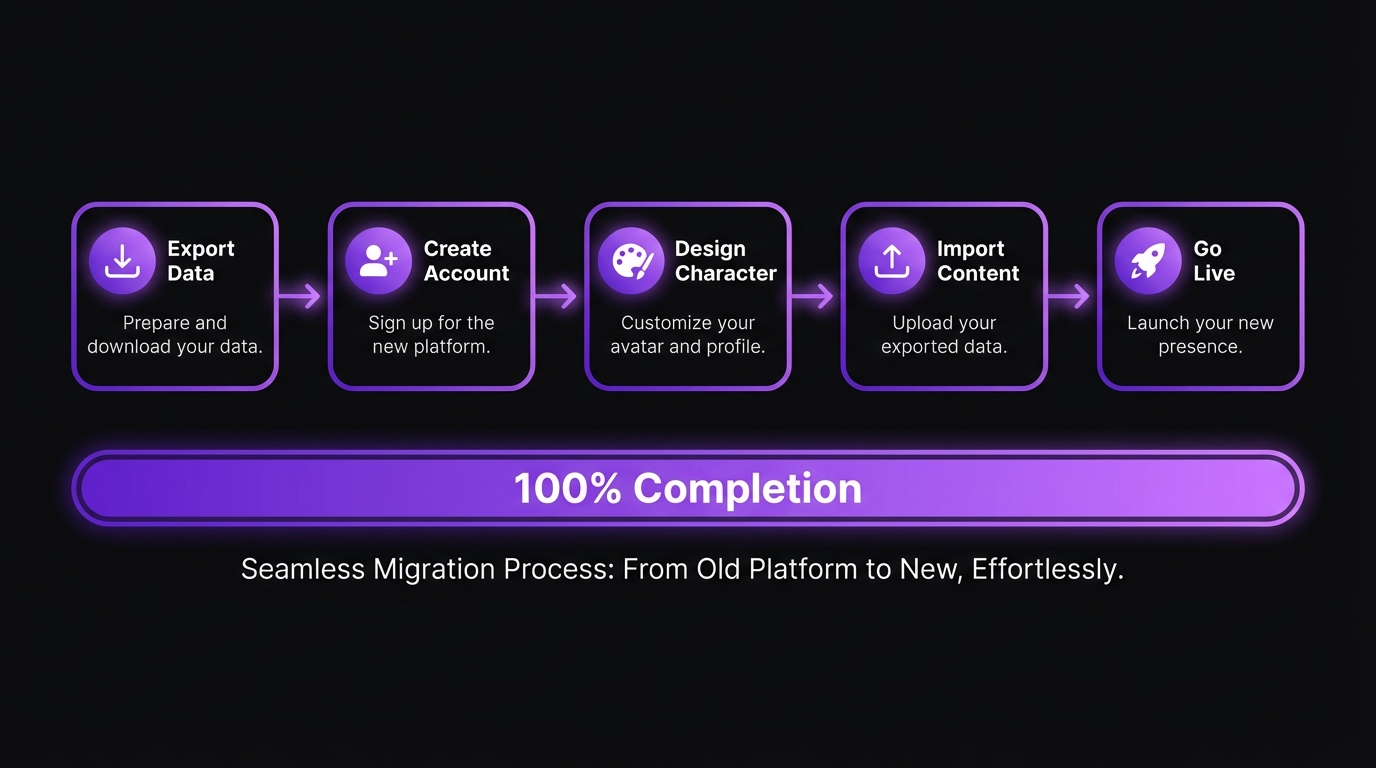
Image generation and character consistency
Higgsfield's Soul ID, Krea's LoRA training, OpenArt's consistent characters, LTX's Elements, Kling's Element Library and MakeInfluencer.ai's influencer profiles all aim at the same problem: the face drifting between shots. They solve it in different places. A trained LoRA lives in the image model. A saved element or profile is passed as a reference into each generation. Custom character training creates a model that produces the character without references.
Do not compare them with one ideal portrait. Run an identity stress test on the same fictional adult character:
- Front-facing portrait in soft window light.
- Three-quarter angle outdoors in hard sun.
- Full-body image in a different outfit.
- Product scene with both hands visible.
- Low-light vertical social image.
- A five-second image-to-video clip from the strongest still.
Score face identity, body consistency, hands, product accuracy and the number of attempts each image needed. The winner is the platform that produces the most usable campaign set per hour, not the prettiest first sample.

Editorial illustration of an identity test set.
A prompt that works well for the first frame on GPT Image 2.5 or Seedream 5.0 Pro, with your character attached as a reference:
Vertical 4:5 photo of the referenced woman, early 30s, standing at a
market stall at 8am, holding a paper cup of coffee in her left hand.
Three-quarter angle, soft overcast light, 50mm lens, natural skin
texture, navy linen shirt with sleeves rolled once. Keep her face,
hairline and eye color identical to the reference. No text.
Change only the setting line for frames two to five, then animate frame one. If the face survives all six, the platform can carry a campaign.
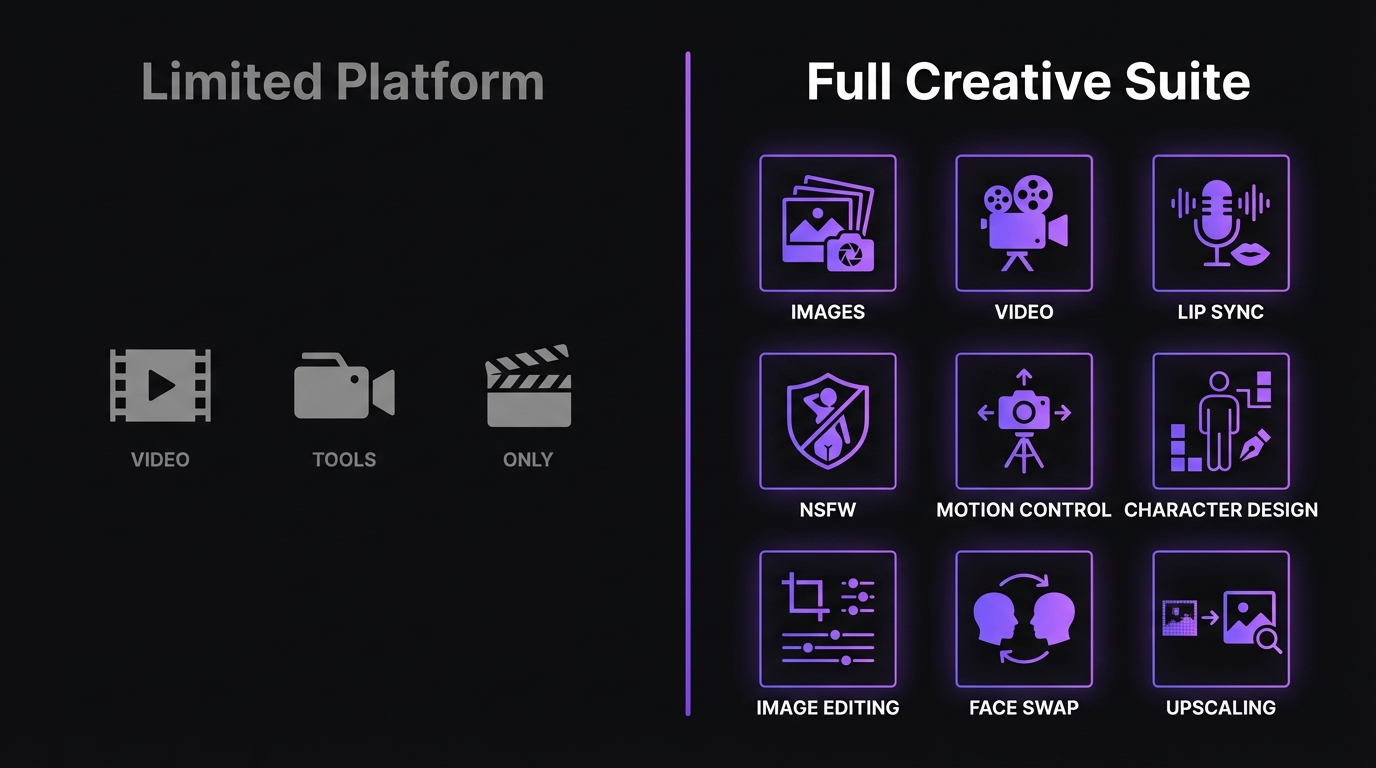
Video generation and creative control
Higgsfield is especially strong when the job is cinematic control: camera presets, effects, Cinema Studio's long references and ad templates. Runway is strongest in editing existing footage. LTX Studio and Kling's Canvas are strongest when you plan shot by shot.
MakeInfluencer.ai's strength is continuity from character to clip:
- Start with an owned influencer image or an uploaded reference.
- Pick a video, motion-control or lip-sync model. Seedance 2.5 generates up to 30 seconds in one pass with native audio and up to 30 reference images; Wan 3.0 reaches 30 seconds with audio at a lower price; Kling 3.0 handles Motion Control; Seedance 2.5 Talking Avatar and InfiniteTalk cover talking clips up to two and ten minutes.
- Check the credit cost, then generate.
- Reuse the output in the Library, in AI Canvas workflows or through the API.
Higgsfield sells a "draft mode" for Seedance 2.5. The same idea works anywhere: draft on a cheap, fast model (Seedance 2.5 Turbo at 720p, or Gemini Omni 1.1 Flash at 360p), then rerun only the winning prompt at full quality. The AI video generator is the manual surface; the image-to-video API guide covers automation.
Compare cost with a real monthly workload
Never compare raw credit counts. A Higgsfield credit, a Krea compute unit, an OpenArt credit and a MakeInfluencer.ai credit buy different amounts of video. Instead, price one realistic month of output on each shortlisted platform:
| Monthly output | Platform A: credits used | Platform A: attempts | Platform B: credits used | Platform B: attempts |
|---|---|---|---|---|
| 30 approved character images | ||||
| 10 image-to-video clips, 5 s, 720p | ||||
| 4 talking clips, 30 s each | ||||
| 5 motion-transfer clips | ||||
| 20 API-generated variants |
Fill in the table during the test below, then convert to money using each plan's price per credit. Add the subscription, any top-up packs, whether failed generations are refunded, queue time, and any separate editor or storage tool you still need. Model API list prices are a useful floor: for reference, ByteDance's Seedance 2.5 lists at $0.36 per second at 720p, its Turbo tier at $0.20, Alibaba's Wan 3.0 at $0.10 and Kuaishou's Kling 3.0 Standard at about $0.08 silent. The AI video model pricing guide has the full table. Any platform that sells you a clip for less than those numbers is either discounting, rationing, or using a cheaper tier.
Who should pick what
AI influencer brand or SFW agency
Choose MakeInfluencer.ai when the same persona needs images, talking clips, motion content and an API under one policy. OpenArt is the budget alternative if you only need consistent images and short clips.
Filmmaker or effects-heavy creator
Stay on Higgsfield or test LTX Studio for storyboards and Runway for editing. None of the character-first tools replaces an effects library.
Performance-marketing team
Test Higgsfield's Marketing Studio against MakeInfluencer.ai's AI UGC creator and Hedra for presenters. Compare the whole route from approved product facts to an exported ad variation, not just the first render. The AI UGC ads guide covers the script side.
Designer who wants every model
Krea for real-time image work and the free daily allowance, Magnific if stock licensing matters.
Developer building generation into a product
MakeInfluencer.ai publishes per-model REST schemas, credit previews and OpenAPI; Higgsfield, Runway, Kling, Hedra, Krea and Pollo all have APIs too. Start each with one inexpensive request and read the error and refund behavior before you write production code. Our REST quickstart is a good template for what to check.
AI agent workflow
Use an MCP server when an agent needs to discover models, check credits, generate and poll. MakeInfluencer.ai, Hedra, OpenArt and Artlist list MCP support; Higgsfield's unlimited windows do not apply to its MCP or CLI.
A fair one-afternoon test
If you already use Higgsfield, do not move everything at once.
Pick two alternatives
Choose the two products from the quick picks that match your main job, plus Higgsfield as the baseline.
Prepare three inputs you own
One character portrait, one product photo and one 20-second voice recording. Export only assets you have the right to reuse.
Run the same four jobs everywhere
One character image, one 5-second image-to-video clip, one 30-second talking clip and one motion-controlled clip, with identical prompts.
Record the evidence
Model, settings, credits spent, attempts, wall-clock time and whether the result is publishable without edits.
Test the automation path
If you plan to use an API or MCP, make one real request on each platform and note how failures and refunds are reported.
Decide on usable output per dollar
Divide the plan price by the number of approved outputs you would get in a month. That number, not the model list, is the comparison.
This keeps the decision tied to your work instead of a generic feature score.
Frequently asked questions
What is the best Higgsfield alternative?
It depends on the job. For a reusable AI influencer across images, video, talking clips and an API, MakeInfluencer.ai. For many models cheaply, Krea. For consistent characters on a budget, OpenArt. For storyboards, LTX Studio. For a proprietary model and editing, Runway. For talking characters, Hedra.
Is there a free Higgsfield alternative?
Several have free allowances: Krea gives 100 compute units a day, Kling is reported at 66 credits a day, LTX Studio gives 800 one-time credits for personal use, Runway gives 125 one-time credits and Pollo gives 20. MakeInfluencer.ai has no free account credits and no free video; the only free generation is a no-sign-up image preview on the AI image generator. Free tiers usually carry lower resolution, watermarks or personal-use limits, so check before publishing.
Are there apps like Higgsfield with the same models?
Yes. Seedance 2.5, Kling 3.0, Wan 3.0, Veo 3.1 and MiniMax H3 are sold by most platforms on this list, including MakeInfluencer.ai, Krea, OpenArt, Magnific, Hedra and Pollo. The differences are price per second, the tools around the model and whether your character carries across generations.
Does Higgsfield have image generation, character consistency and lip sync?
Yes to all three. Higgsfield offers image models, Soul ID for character consistency and Higgsfield Speak for voice and lip sync. Pages that say otherwise are out of date.
Does Higgsfield have an API?
Yes, since 16 September 2026: a pay-per-use API with its own models and resold third-party models. Its documentation points to the console for the full model list. Unlimited plan windows do not apply to MCP or CLI usage.
Is Higgsfield unlimited really unlimited?
Only for specific models, for specific periods, on higgsfield.ai itself. Higgsfield's own blog describes a year-long unlimited set of six image models on Plus and Ultra, short windows for new flagship models, and credits for MCP, CLI, Canvas, Supercomputer and Marketing Studio.
Which Higgsfield alternative is best for developers?
Look for published per-model schemas, a way to preview cost before a request, clear failure and refund semantics, and an MCP server if agents are involved. MakeInfluencer.ai documents all four; Higgsfield, Runway, Kling, Hedra, Krea and Pollo also have APIs worth testing.
Are MakeInfluencer.ai API generations more expensive than dashboard generations?
No. Dashboard, REST and MCP share one balance and one model price, and previewing a request does not charge credits.
Final verdict
Higgsfield is a capable creative suite with real image, video, character, ad and API features, and the right alternative is the one that fits the part of your work Higgsfield does not. Choose MakeInfluencer.ai for one SFW character across every format with a documented API and a credit quote before every run. Choose Krea or Pollo for cheap model sampling, OpenArt for budget character work, LTX Studio for storyboards, Runway for editing, Kling for Kling-first work, Hedra for talking characters, and Magnific or Artlist if stock licensing is already part of your budget.
Run the one-afternoon test on two of them before you commit. Current MakeInfluencer.ai plans are on the pricing page, you can draft images with the free AI image generator preview without an account, and questions go to [email protected].